
Three Years, One Decision Layer: How Coast Runs Credit, Fraud and Compliance on Oscilar
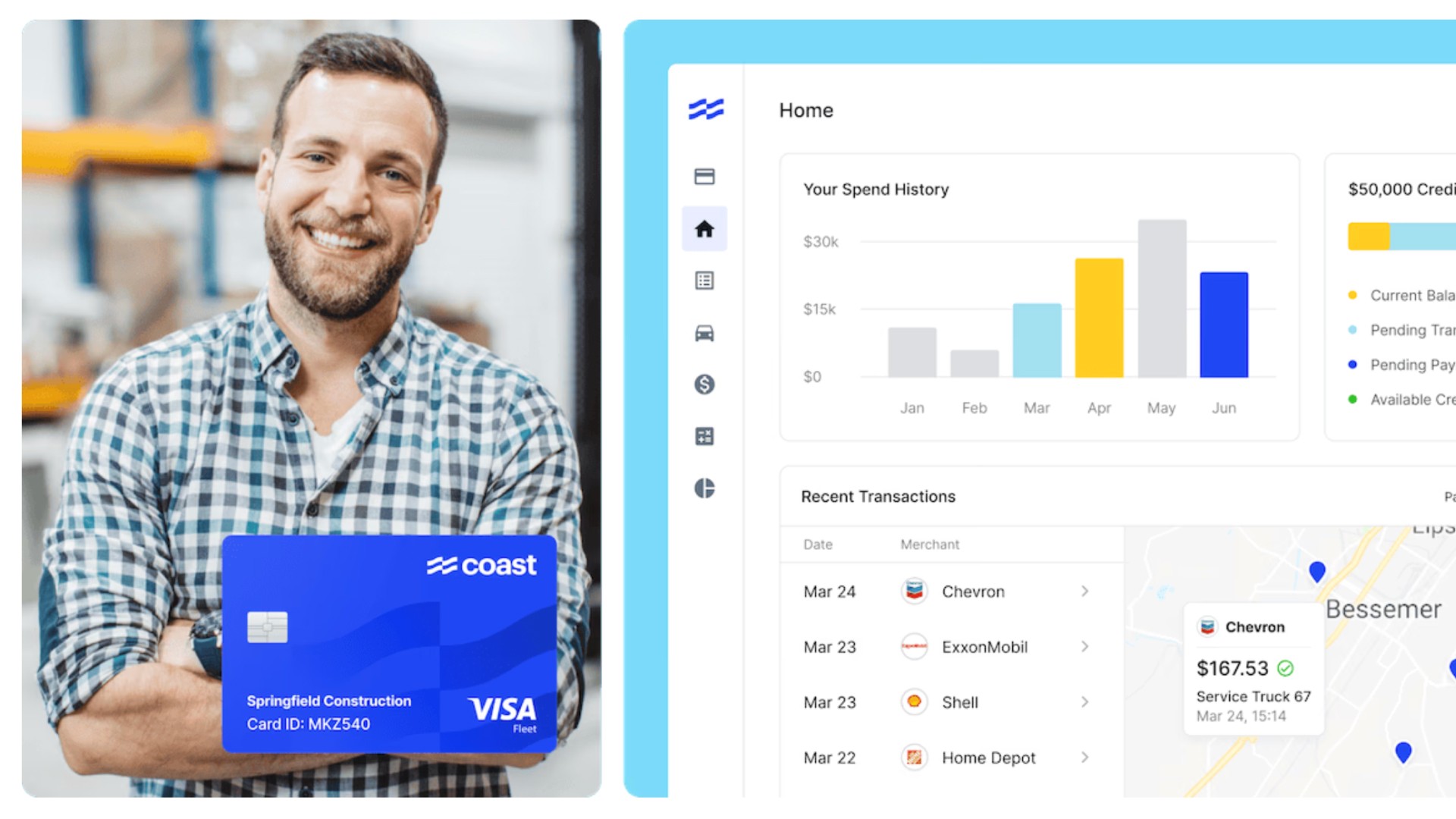
750
hours saved per year
75%
manual review time savings
>50%
less time on document review
About
Coast
Coast is the financial platform for the trades and transportation. Thousands of fleet-operating businesses in field service, construction, logistics and long-haul trucking use Coast's fleet and fuel cards, corporate cards, expense management and bill pay to control spending in the field and simplify their finances. Coast is re-imagining the trillion-dollar US B2B card payments infrastructure, with a focus on the country's 500,000 commercial fleets, 40 million commercial vehicles, and many million commercial drivers.
Use Case/s
Credit Underwriting
Fraud Detection
AML Operations
Case Management
Agents
Industry
Financial Services
Visit their website
↗
The Challenge
Fabricated businesses pass for the real thing
Coast’s risk problem starts with a deceptively simple question: is the business in front of you real? Generative AI has made that much harder to answer. The signals that once helped establish legitimacy, a professional website, credible financial documents, a convincing verification call, are now easier to manufacture at scale. First-party fraudsters can build a plausible business identity before Coast ever sees the application.
"Right now anyone can make a website. Anyone can make fake bank statements that look just like a major bank’s PDF. They can go to a chatbot and ask: what’s my persona if they call me,” said Delia Nuñez, Coast’s Director of Risk and Analytics. "Three years ago it was easier to catch a fraudster on the phone. Now they know exactly what to say."
At the same time, Coast has less data to verify a business than a consumer lender would have for an individual. Business credit reporting is thinner, particularly as companies become larger and more complex. That puts more weight on the signals Coast can assemble around an applicant and raises the stakes of distinguishing a legitimate business from one built to look legitimate.
Coast’s answer is to gather more evidence without automatically creating more friction, asking customers for additional documents only when the signals already available are not enough. But before Oscilar, the operation behind those decisions was still heavily manual. Analysts relied on data pulls, hundred-line queries and spreadsheets, spent roughly two hours a day on review, and had no systematic record of why one decision differed from another.
Coast needed a decision layer that could bring those signals together, adapt as swiftly as fraud changed, and give the risk team control without waiting on engineering. In 2023, it started building that layer on Oscilar, beginning with credit limit decisions and case management.
" width="48px"><path d="M 46.882 0.008 L 35.413 0.008 C 34.868 0.008 34.402 0.403 34.323 0.933 C 34.141 2.15 33.841 3.32 33.453 4.426 C 32.117 8.268 29.651 11.437 26.545 13.389 L 26.577 13.389 C 26.577 13.389 35.2 13.168 38.085 4.426 L 38.085 4.426 L 42.677 4.426 C 40.772 9.904 36.591 14.014 31.501 15.168 C 30.56 15.381 29.596 15.492 28.6 15.492 C 26.988 15.492 25.439 15.2 23.984 14.654 C 19.684 13.05 16.207 9.264 14.523 4.418 C 14.128 3.304 13.835 2.134 13.654 0.925 C 13.575 0.387 13.108 0 12.563 0 L 1.11 0 C 0.438 0 -0.084 0.601 0.011 1.265 C 0.161 2.348 0.383 3.399 0.675 4.426 C 3.181 13.397 10.611 19.91 19.368 19.918 C 15.108 18.472 8.445 14.433 5.307 4.426 L 5.307 4.426 L 5.307 4.426 L 9.899 4.426 C 11.101 8.71 13.424 12.449 16.483 15.168 C 18.665 17.112 21.218 18.543 24 19.302 C 25.478 19.705 27.027 19.918 28.616 19.918 C 37.382 19.918 44.819 13.397 47.325 4.426 C 47.609 3.407 47.831 2.348 47.989 1.265 C 48.084 0.601 47.562 0 46.89 0 Z" fill="rgb(20, 20, 20)" height="19.91824092137921px" id="Hl4ydHRG3" transform="translate(0 24.337)" width="48.00000000004601px"/><path d="M 1.11 19.918 L 12.579 19.918 C 13.124 19.918 13.59 19.523 13.669 18.993 C 13.851 17.776 14.152 16.606 14.539 15.5 C 15.875 11.658 18.333 8.489 21.431 6.537 L 21.407 6.537 C 21.407 6.537 12.784 6.758 9.899 15.5 L 9.899 15.5 L 5.307 15.5 L 5.307 15.5 C 7.204 10.022 11.393 5.904 16.475 4.75 C 17.416 4.537 18.38 4.426 19.376 4.426 C 20.989 4.426 22.538 4.719 23.992 5.264 C 28.292 6.869 31.77 10.655 33.453 15.5 L 33.453 15.5 L 33.453 15.5 C 33.848 16.614 34.141 17.784 34.323 18.993 C 34.402 19.531 34.868 19.918 35.413 19.918 L 46.882 19.918 C 47.554 19.918 48.076 19.318 47.981 18.654 C 47.831 17.579 47.609 16.519 47.317 15.492 C 44.819 6.529 37.374 0 28.608 0 C 32.868 1.446 39.539 5.478 42.685 15.5 L 42.685 15.5 L 38.093 15.5 L 38.093 15.5 L 38.093 15.5 C 36.899 11.208 34.568 7.477 31.509 4.75 C 29.327 2.806 26.774 1.383 24 0.617 C 22.514 0.213 20.973 0 19.384 0 C 10.611 0 3.173 6.529 0.675 15.5 L 0.675 15.5 L 0.675 15.5 C 0.391 16.527 0.169 17.579 0.011 18.661 C -0.084 19.325 0.438 19.926 1.11 19.926 Z" fill="rgb(20, 20, 20)" height="19.926144985236892px" id="Jt1DMWCge" transform="translate(0 0)" width="47.99209593618835px"/></g></svg>)
Oscilar's Impact
Credit proved the model, fraud and compliance followed
Coast started on Oscilar with credit limit decisions and case management, where the value showed up immediately. Manual review time fell from two hours per analyst per day to under 30 minutes, a 75% reduction that returned roughly 750 hours a year to the team at its size.
"We’ve been able to move away from building hundred-line, complex queries, and can now maintain all of our fraud rules within Oscilar."
Delia Nuñez
Director of Risk and Analytics
Coast
Just as important, the risk team could manage more of the logic itself. “We’ve been able to move away from building hundred-line, complex queries, and can now maintain all of our fraud rules within Oscilar,” Nuñez said.
That early experience changed how Nuñez thought about the platform. "I said this very early on when we partnered with Oscilar: I feel like you can use this for everything."
What she saw was a reusable decision layer, not a point solution. Coast could bring in its own data and third-party signals, define new attributes, and apply different logic without standing up another system each time. Credit proved the model first. Fraud followed, then transaction monitoring, sanctions screening and AML, each running on the same customer context.
When fraud changes, Coast can adapt the same day
Three years later, one of the biggest differences is how quickly Coast can respond when a new pattern emerges.
“We've had fraud ring attacks. We've had instances where we checked revenue but then saw credit bust-out behavior,” Nuñez said. “It doesn't take us months, weeks, days. Same day we can go in and tweak.”
Coast's analysts can make those changes themselves. They can test new logic against historical outcomes, see the effect on false positives, inspect the signals behind a spike or miss, and revert a change before it creates problems. AI-assisted workflow building makes it faster to turn an idea into something the team can test.
That gives Coast speed without giving up control. As fraud changes, the team can adjust its decisioning the same day and validate the impact before the new logic goes live.
Scaling the book without scaling the work
As Coast grew, the risk team used automation to keep more of that growth from turning into manual work. “Being able to fine-tune rules and fine-tune where we focus has allowed our team to stay extremely lean,” Nuñez said. “We can very quickly see what's triggering good versus bad cases: where are we wasting our time versus what's effective, how can we automate. We've been able to scale tremendously while still keeping the team lean and functional.”
"We've been able to scale tremendously while still keeping the team lean and functional.”
Delia Nuñez
Director of Risk and Analytics
Coast
Much of that leverage comes from stopping unnecessary work before it reaches an analyst. Cases can be suppressed when they do not warrant review, actioned automatically when the evidence is sufficient, and carried forward with context from previous cases on the same fleet.
Nuñez saw the contrast while interviewing a candidate whose previous job was largely to review bank statements by hand. “I thought, that's insane,” she said. “We rely on a very strong signal without having a single person go in and review bank statements.”
For Coast, that is the value of building automation into the decision layer rather than around it. Case management, suppression and end-to-end workflows have become infrastructure the team can keep extending as the portfolio grows, instead of recreating the same operational work at a larger scale.
Data partners plug seamlessly into the same decisioning workflow
Adding a new data partner does not have to create another system or workflow. Inscribe is the clearest example.
Coast had used Inscribe, an agentic document fraud detection platform, for years to analyze bank statements for signs of tampering and extract credit-relevant attributes, but that step sat outside Oscilar. In 2026, Coast brought it into the existing case flow. Now an analyst can request documents from the case, Oscilar sends the request through Inscribe, and the resulting attributes flow straight back into the decision. Cases that meet Coast’s criteria can close without an analyst reopening them.
For Nuñez, the value is not just the integration itself but how easily it becomes part of the existing decision process. "I don't need an engineer," she said. "If you need anything around revenue verification or document fraud checks, it's just part of one flow within Oscilar."
[A companion post on the Oscilar blog tells the Oscilar and Inscribe story in full.]
Results
Still building together, three years on
Oscilar and Coast have kept a standing weekly call since 2023. "We still have our weeklies with Oscilar, three years strong, which I think is pretty impressive," Nuñez said. "I thought we were eventually going to be forgotten, and we haven't been."
Those calls are real working sessions. Coast brings a problem or an idea, the teams work through how the platform could solve it, and sometimes that conversation turns into product. The Inscribe integration began that way, moving from Nuñez’s request to a working integration inside Coast’s existing workflows over one summer.
Three years in, Oscilar is still building alongside Coast. That ongoing collaboration has helped the platform keep expanding with Coast's growth.
From decisioning to agents: Putting three years of Coast intelligence to work
Coast started on Oscilar with credit decisioning and case management in 2023, then expanded into fraud, transaction monitoring, sanctions screening and AML. Each new use case added more decision history, case outcomes and performance data. Next, Coast is open to putting that accumulated intelligence to work through agents.
Credit is a likely place to start. Coast has deliberately kept its proactive credit limit increases conservative. Now the team wants to know what its own performance history says about moving those thresholds, and what the impact would be on precision and recall.
That kind of analysis would traditionally require a data scientist. "I don’t have a data scientist on my team. We don’t have an in-house machine learning capability," Nuñez said. "Having a way to offload that is pretty great."
"I don’t have a data scientist on my team. We don’t have an in-house machine learning capability. Having a way to offload that is pretty great."
Delia Nuñez
Director of Risk and Analytics
Coast
Oscilar’s rule recommender agent is built for that question, and Coast is open to putting it to work. The agent would analyze Coast’s decision history, identify where a threshold could move and estimate the expected impact before anything changes. Coast's team would review the recommendation and decide whether to act.
Any move to agents would follow the same pattern Coast has used from the beginning: prove a use case, measure it against its own data, then expand. Anurag Puranik, Coast’s Chief Risk Officer, describes it this way: "We started with one problem, credit limit decisions, and proved it out before we asked Oscilar to do anything else. Every expansion since has landed on the same decisioning layer, so each new use case made the last one stronger. Agents are the next step, and we’ll adopt them the same way."
"We started with one problem, credit limit decisions, and proved it out before we asked Oscilar to do anything else. Every expansion since has landed on the same decisioning layer, so each new use case made the last one stronger. Agents are the next step, and we’ll adopt them the same way."

Anurag Puranik
Chief Risk Officer
Coast
What makes that next step possible is the context an agent would inherit. It would not start from scratch in a separate AI system. It would work from the decision history, performance data and controls Coast has accumulated as Oscilar expanded from credit into fraud and compliance.
Neha Narkhede, Oscilar’s co-founder and CEO, sees that continuity as the foundation for agentic risk. "Every risk leader wants to move at the speed fraud moves. Very few can, because their decisions live in systems that don’t share a memory. Coast made a different choice three years ago and has put every expansion since onto the same record of the customer. That is why the team can change course the same day a pattern shifts, and it is the foundation an agent can earn trust on."
Over three years, Coast has expanded Oscilar from credit decisioning and case management into fraud, transaction monitoring, sanctions screening, and AML, with agents as the next step. Each new capability has built on the same decision layer rather than creating another system beside it.
What began with one workflow has become the operating layer for Coast’s risk program. Nuñez puts it simply: "It’s a core part of our infrastructure."

" height="48px" id="Qi9pnIQwR" width="48px"/></g></svg>)
" height="39.77194px" id="A8r2uGwai" transform="translate(2 3.808)" width="44px"/></svg>)

