
Last updated: January 2026
Google just unveiled the Universal Commerce Protocol at the National Retail Federation conference, an open-source standard that could become the invisible infrastructure layer for every AI-mediated purchase on earth.
Co-developed with Shopify, Target, Walmart, Etsy, and Wayfair, and endorsed by Visa, Mastercard, Stripe, and American Express, this protocol enables AI agents to autonomously handle discovery, checkout, payments, returns, and loyalty rewards without human intervention.
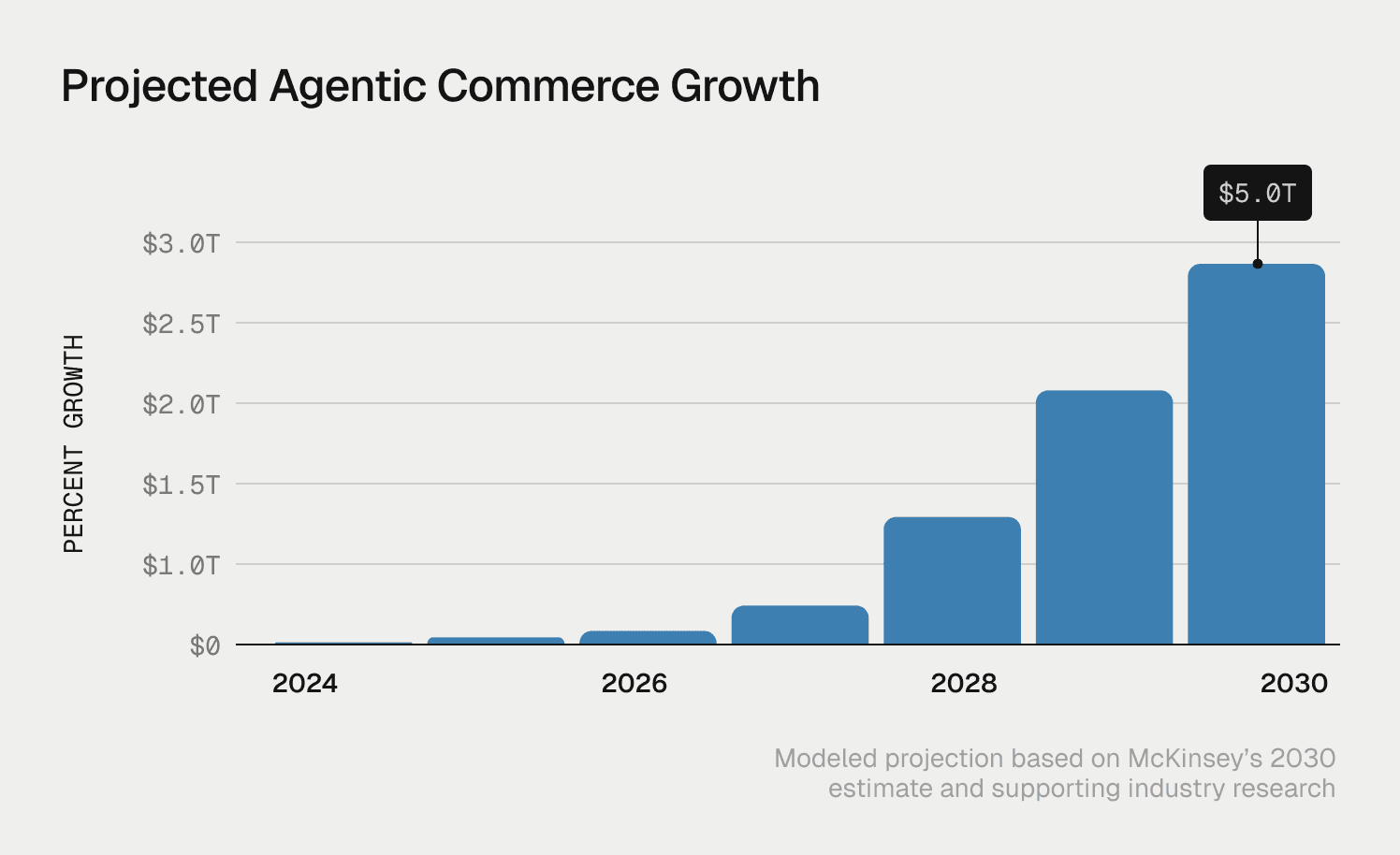
McKinsey projects that $3 to $5 trillion in global commerce could flow through AI agents by 2030. The Universal Commerce Protocol is Google’s bid to become the rails on which that future runs.
TL;DR
Google’s Universal Commerce Protocol lets AI agents handle shopping tasks like finding products, checking out, handling payments, returns, and loyalty
The protocol replaces one-off merchant integrations with a single shared standard, making it easier for AI agents to buy from many retailers
Brands compete less on ads and website design and more on clean data, reliable inventory, and fulfillment performance
Payment companies like Visa, Mastercard, and Stripe are shifting focus from checkout fees to verifying agents and managing risk
AI-driven commerce needs AI-native trust systems, including ways to verify AI agents, confirm user permission, and detect fraud
What problem does the Universal Commerce Protocol actually solve?
Today, every AI platform, whether ChatGPT, Google AI Mode, or Perplexity AI,would require custom integrations with every merchant to enable autonomous purchasing.
Engineers refer to this as the N×N problem, and it is fundamentally unscalable.
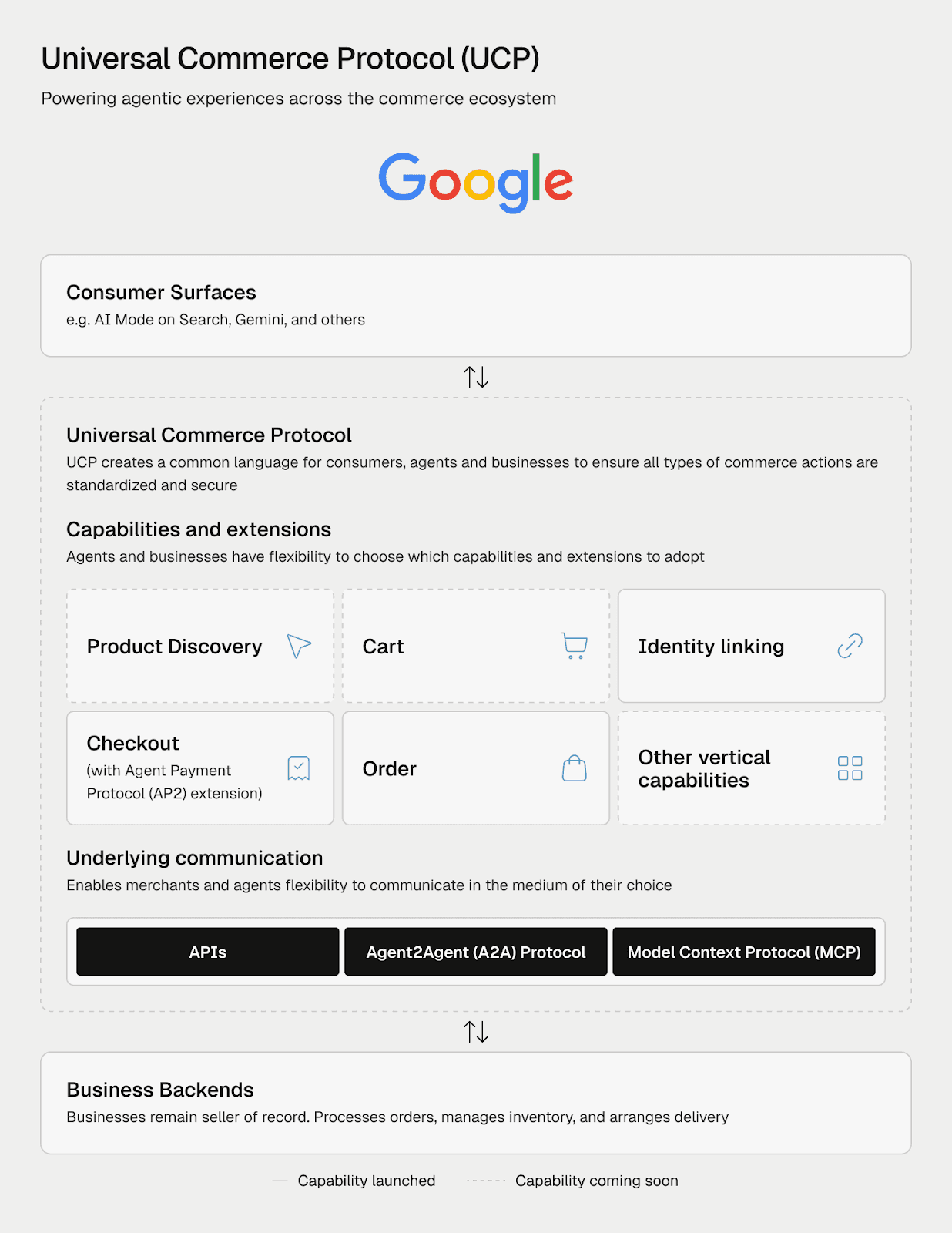
According to Google’s technical documentation, UCP collapses N×N complexity into a single integration point by introducing a standardized commerce language.Merchants publish their capabilities at a known endpoint andAI agents dynamically discover what each merchant supports without hardcoded integrations.
When a user says “find me a lightweight suitcase,” an AI agent queries Google’s Shopping Graph,which contains over 50 billion product listings refreshed more than 2 billion times hourly,and generates parallel searches across price, brands, reviews, shipping times, and availability.
This is the difference between AI assisting commerce and AI operating commerce.
How will brands compete when AI agents control discovery?
Brands now face a paradox: they are simultaneously more important and less visible.
When AI agents mediate discovery, traditional brand experiences like websites, packaging aesthetics, and in-store environments matter less. Differentiation shifts from persuasive marketing messages to structured data that agents can parse.
BCG research warns that without swift intervention, retailers risk being reduced to undifferentiated utilities inside agent-controlled marketplaces.
At the same time, operational excellence becomes the competitive moat. AI agents remember every merchant interaction. Accurate inventory, reliable fulfillment, and consistent quality compound into trust signals that drive default recommendations.
Adobe data shows traffic to U.S. retail sites from generative AI sources surged 4,700% year-over-year in July 2025, with visitors spending 32% more time on site with 27% lower bounce rates.
What the Universal Commerce Protocol means for Visa, Mastercard, and Stripe
The Universal Commerce Protocol commoditizes the checkout layer that traditional payment providers once controlled.
Value shifts upstream to identity verification, authorization, and risk assessment. Visa has responded with the Trusted Agent Protocol, developed in collaboration with Cloudflare, which cryptographically verifies that an AI agent is legitimate and acting on a user’s behalf. Visa issues agent-linked payment tokens that function like credit cards for AI agents, linked to the consumer’s original account.
According to Visa’s December announcement, hundreds of secure agent-initiated transactions have already been completed in production.
In an agentic economy, payment providers competing solely on transaction fees face margin compression. The winners will differentiate on trust infrastructure, global coverage, and risk intelligence.
Why trust is the fundamental barrier to agentic commerce adoption
According to Bain & Company research, only 24% of U.S. consumers feel comfortable using AI to complete purchases today. Accenture’s Future of Money study found that 78% of financial institution leaders expect fraud to increase significantly due to agentic commerce. New fraud vectors include agent impersonation, consent manipulation, data poisoning, and prompt injection attacks hidden in product descriptions.
This is why companies like Oscilar will become increasingly critical, providing the real-time risk, fraud detection, and authorization controls needed to secure autonomous, AI-driven transactions.
Why agentic commerce requires reimagined risk infrastructure
Agentic commerce introduces risks that existing systems were never designed to handle. When transactions are initiated and executed by AI agents, trust can no longer rely on controls built for human behavior. A new risk model is required.
Components of this new risk infrastructure include:
Know Your Agent (KYA): Just as KYC verifies customers, systems must verify AI agents. Risk, compliance, and identity providers will need to adapt existing KYC and AML frameworks to identify, authenticate, and monitor non-human actors.
Real-time behavioral analysis: Legacy fraud tools analyze human behavior. AI agents require different signals, such as transaction velocity, API usage patterns, and anomalous capability execution.Cryptographic consent verification: The Universal Commerce Protocol’s AP2 extension supports “mandates,” which are cryptographically signed records proving user authorization. These mandates create auditable trails for disputes and compliance.
Continuous authentication: Unlike one-time checkout authentication, agent-mediated commerce requires ongoing verification throughout the full transaction lifecycle.
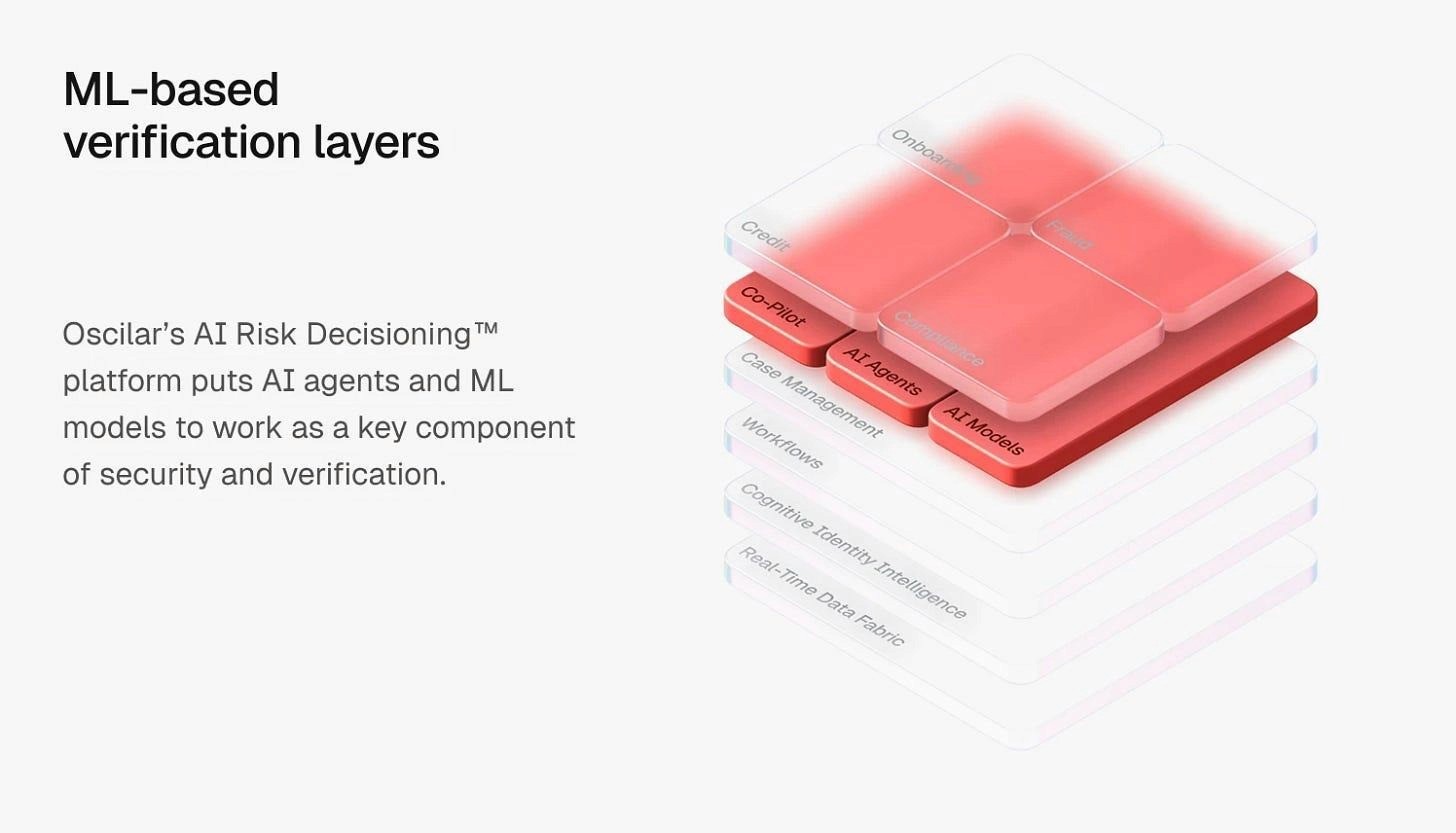
This is where platforms like Oscilar become critical. Oscilar’s AI Risk Decisioning™ platform adds real-time intelligence to detect fraud, anomalies, and compliance issues in machine-initiated transactions, filling the trust gap created by autonomous commerce.
Together, protocols like the Universal Commerce Protocol and Trusted Agent Protocol, combined with AI-native risk decisioning, form the emerging trust stack of agentic commerce.
The urgency is clear. Accenture research shows that 85% of financial institutions believe their current systems are not equipped to handle high-volume, agent-initiated transactions, and 60% lack a dedicated response plan for agent-driven fraud.
What happens next as agentic commerce moves into production
Agentic commerce is moving quickly from experimentation to real-world deployment. Over the next few years, the biggest changes will come in waves, as infrastructure providers, merchants, and regulators respond to AI agents becoming active participants in commerce.
2026–2027: Rapid adoption and early disruption
In the near term, payment and commerce infrastructure providers will move quickly to integrate with Google’s Universal Commerce Protocol. For many, this is a requirement to remain compatible with AI agents.
As reported by TechCrunch, the protocol already works with existing standards such as Agent2Agent, Agent Payments Protocol, and Model Context Protocol, which lowers the technical barrier to adoption and speeds up integration timelines.
As agent-driven purchases grow, demand for AI-native fraud and risk platforms will increase, since legacy systems are built for human behavior. Comparison and affiliate sites will lose relevance, while merchants invest more in clean product data, accurate inventory, and better APIs.
2027–2029: Consolidation, trust, and regulation
By the late 2020s, protocol consolidation becomes unavoidable. Either the Universal Commerce Protocol becomes the default, or fragmentation recreates the same problems at the integration level.
New markets will form around agent verification, authorization, and risk scoring, making trust as important as payment processing. Regulators will step in, with European authorities already examining Google’s influence.
What’s next for agentic commerce
Google is not playing for transaction fees. It is playing for infrastructure primacy.
Controlling the protocol layer means even when purchases happen through OpenAI’s ChatGPT or Amazon’s Alexa, those agents must speak Universal Commerce Protocol to access the merchant ecosystem.
As Shopify CEO Tobi Lütke noted at the announcement, agentic commerce enables “serendipity” where AI finds products consumers would never have searched for themselves“and this kind of serendipity is where the best of commerce happens.”
So the trillion-dollar question is not whether agentic commerce happens. It is whether commerce infrastructure consolidates around one protocol or fragments across many.
Google has engineered the Universal Commerce Protocol as the HTTP of shopping: open, extensible, and economically aligned with ecosystem growth.
History suggests that is exactly how winning infrastructure protocols behave.

Linas Beliūnas
Former Content Strategist
Linas is a business developer, sales professional, and FinTech strategist with over six years of experience driving innovation in financial services. Passionate about leveraging technology to reinvent finance, he has worked across leading institutions—including Western Union, Danske Bank, and Norne Securities—before focusing fully on FinTech. Linas is particularly interested in digital banking, payments, emerging technologies, and blockchain and cryptocurrency. He shares insights with a global audience of 116,000+ professionals through his newsletter at linas.substack.com.

" height="48px" id="Qi9pnIQwR" width="48px"/></g></svg>)
" height="39.77194px" id="A8r2uGwai" transform="translate(2 3.808)" width="44px"/></svg>)


" height="22.301126233991734px" id="PeyDPUyWO" transform="translate(45.365 4.852)" width="20.043580159797898px"/><path d="M 13.46 11.116 C 12.368 10.493 10.888 9.973 9.024 9.556 C 7.664 9.236 6.613 8.927 5.887 8.624 C 5.155 8.321 4.647 7.979 4.355 7.59 C 4.064 7.201 3.921 6.704 3.921 6.104 C 3.921 5.184 4.269 4.447 4.972 3.898 C 5.675 3.349 6.624 3.069 7.83 3.069 C 8.79 3.069 9.607 3.241 10.282 3.578 C 10.951 3.921 11.482 4.401 11.876 5.018 C 12.265 5.641 12.511 6.361 12.614 7.184 L 16.1 6.973 C 15.94 5.63 15.523 4.435 14.854 3.383 C 14.185 2.332 13.265 1.503 12.105 0.903 C 10.945 0.303 9.539 0 7.899 0 C 6.355 0 5.024 0.263 3.904 0.783 C 2.783 1.303 1.92 2.035 1.32 2.978 C 0.72 3.921 0.417 5.001 0.417 6.224 C 0.417 7.344 0.646 8.281 1.109 9.036 C 1.572 9.785 2.315 10.419 3.349 10.928 C 4.384 11.436 5.755 11.905 7.481 12.328 C 9.024 12.688 10.19 13.059 10.985 13.442 C 11.774 13.825 12.311 14.237 12.591 14.688 C 12.871 15.14 13.014 15.666 13.014 16.266 C 13.014 16.906 12.848 17.455 12.517 17.906 C 12.185 18.358 11.705 18.695 11.076 18.912 C 10.448 19.135 9.676 19.243 8.779 19.243 C 7.739 19.243 6.847 19.072 6.104 18.735 C 5.361 18.392 4.778 17.883 4.344 17.203 C 3.915 16.523 3.629 15.689 3.486 14.711 L 0 14.923 C 0.103 16.403 0.514 17.7 1.246 18.798 C 1.977 19.901 2.972 20.764 4.235 21.381 C 5.498 22.004 6.99 22.313 8.71 22.313 C 10.27 22.313 11.636 22.061 12.797 21.564 C 13.957 21.061 14.871 20.341 15.528 19.398 C 16.191 18.455 16.523 17.346 16.523 16.06 C 16.523 15.02 16.289 14.094 15.814 13.282 C 15.346 12.471 14.563 11.756 13.471 11.133 Z" fill="rgb(20, 20, 20)" height="22.312556870217108px" id="ZaBOTiDLx" transform="translate(68.34 4.858)" width="16.522951309374434px"/><path d="M 13.682 17.877 C 12.751 18.792 11.442 19.243 9.762 19.243 C 8.522 19.243 7.43 18.923 6.504 18.283 C 5.572 17.643 4.847 16.723 4.326 15.517 C 3.806 14.317 3.543 12.871 3.543 11.191 C 3.543 9.51 3.801 8.093 4.309 6.876 C 4.818 5.664 5.544 4.727 6.487 4.064 C 7.43 3.401 8.533 3.069 9.79 3.069 C 11.373 3.069 12.619 3.486 13.534 4.315 C 14.443 5.149 15.031 6.281 15.294 7.727 L 18.901 7.544 C 18.438 5.178 17.472 3.332 16.003 2 C 14.528 0.669 12.459 0 9.796 0 C 7.83 0 6.115 0.457 4.641 1.366 C 3.166 2.28 2.029 3.572 1.217 5.241 C 0.406 6.916 0 8.893 0 11.179 C 0 13.465 0.412 15.494 1.235 17.146 C 2.058 18.798 3.201 20.072 4.675 20.964 C 6.15 21.855 7.847 22.301 9.767 22.301 C 11.528 22.301 13.054 21.975 14.334 21.324 C 15.614 20.672 16.654 19.752 17.443 18.558 C 18.232 17.363 18.758 15.957 19.021 14.334 L 15.443 14.151 C 15.203 15.711 14.614 16.952 13.682 17.86 Z" fill="rgb(20, 20, 20)" height="22.301126257066386px" id="dj2F9fN0f" transform="translate(87.772 4.841)" width="19.020540282808156px"/><path d="M 0 21.335 L 0 0 L 3.423 0 L 3.423 21.335 Z" fill="rgb(20, 20, 20)" height="21.335239445830055px" id="fvIs54YbW" transform="translate(110.485 5.332)" width="3.423468638642248px"/><path d="M 3.429 0 L 0 0 L 0 21.341 L 13.762 21.341 L 13.762 18.272 L 3.429 18.272 Z" fill="rgb(20, 20, 20)" height="21.340954752405395px" id="KykvynROU" transform="translate(118.389 5.332)" width="13.762458233473922px"/><path d="M 9.859 3.303 L 16.077 21.335 L 19.684 21.335 L 11.991 0 L 7.693 0 L 0 21.335 L 3.635 21.335 L 9.853 3.303 Z" fill="rgb(20, 20, 20)" height="21.33523944583004px" id="Ln_a1JZTX" transform="translate(133.986 5.338)" width="19.683515845550573px"/><path d="M 11.545 12.499 C 12.968 12.059 14.043 11.322 14.774 10.293 C 15.506 9.259 15.871 8.024 15.871 6.584 C 15.871 4.521 15.191 2.909 13.825 1.743 C 12.465 0.583 10.539 0 8.053 0 L 0 0 L 0 21.335 L 3.423 21.335 L 3.423 13.071 L 8.201 13.071 L 12.802 21.335 L 16.529 21.335 L 11.539 12.499 Z M 11.173 9.116 C 10.402 9.705 9.327 10.002 7.944 10.002 L 3.435 10.002 L 3.435 3.058 L 7.944 3.058 C 9.327 3.058 10.402 3.361 11.173 3.961 C 11.945 4.561 12.328 5.435 12.328 6.573 C 12.328 7.71 11.945 8.522 11.173 9.11 Z" fill="rgb(20, 20, 20)" height="21.335239490803623px" id="Qt9AxOqZR" transform="translate(156.099 5.338)" width="16.528666547835087px"/><path d="M 33.9 0.006 L 25.607 0.006 C 25.213 0.006 24.875 0.291 24.818 0.674 C 24.687 1.555 24.47 2.4 24.19 3.201 C 23.224 5.978 21.44 8.27 19.194 9.682 L 19.217 9.682 C 19.217 9.682 25.453 9.522 27.539 3.201 L 27.539 3.201 L 30.859 3.201 C 29.482 7.161 26.459 10.133 22.778 10.968 C 22.098 11.122 21.4 11.202 20.68 11.202 C 19.514 11.202 18.394 10.991 17.343 10.596 C 14.233 9.436 11.719 6.698 10.501 3.195 C 10.216 2.389 10.004 1.543 9.873 0.669 C 9.816 0.28 9.478 0 9.084 0 L 0.803 0 C 0.317 0 -0.061 0.434 0.008 0.914 C 0.117 1.697 0.277 2.458 0.488 3.201 C 2.3 9.687 7.672 14.397 14.005 14.403 C 10.924 13.357 6.106 10.436 3.837 3.201 L 3.837 3.201 L 3.837 3.201 L 7.158 3.201 C 8.027 6.298 9.707 9.002 11.919 10.968 C 13.496 12.374 15.342 13.408 17.354 13.957 C 18.423 14.248 19.543 14.403 20.692 14.403 C 27.03 14.403 32.408 9.687 34.22 3.201 C 34.426 2.463 34.586 1.697 34.7 0.914 C 34.769 0.434 34.391 0 33.906 0 Z" fill="rgb(20, 20, 20)" height="14.402572631835938px" id="yxyckXN6_" transform="translate(0 17.597)" width="34.708059114564385px"/><path d="M 0.803 14.403 L 9.095 14.403 C 9.49 14.403 9.827 14.117 9.884 13.734 C 10.016 12.854 10.233 12.008 10.513 11.208 C 11.479 8.43 13.256 6.138 15.497 4.727 L 15.479 4.727 C 15.479 4.727 9.244 4.887 7.158 11.208 L 7.158 11.208 L 3.837 11.208 L 3.837 11.208 C 5.209 7.247 8.238 4.269 11.913 3.435 C 12.593 3.281 13.29 3.201 14.011 3.201 C 15.176 3.201 16.297 3.412 17.348 3.806 C 20.457 4.967 22.972 7.704 24.19 11.208 L 24.19 11.208 L 24.19 11.208 C 24.475 12.014 24.687 12.859 24.818 13.734 C 24.875 14.123 25.213 14.403 25.607 14.403 L 33.9 14.403 C 34.386 14.403 34.763 13.968 34.694 13.488 C 34.586 12.711 34.426 11.945 34.214 11.202 C 32.408 4.721 27.024 0 20.686 0 C 23.767 1.046 28.59 3.961 30.865 11.208 L 30.865 11.208 L 27.544 11.208 L 27.544 11.208 L 27.544 11.208 C 26.681 8.104 24.995 5.407 22.784 3.435 C 21.206 2.029 19.36 1 17.354 0.446 C 16.28 0.154 15.165 0 14.016 0 C 7.672 0 2.294 4.721 0.488 11.208 L 0.488 11.208 L 0.488 11.208 C 0.282 11.951 0.122 12.711 0.008 13.494 C -0.061 13.974 0.317 14.408 0.803 14.408 Z" fill="rgb(20, 20, 20)" height="14.408287876490093px" id="fJajgayao" width="34.70234380798904px"/></g></svg>)