

Money20/20 Europe brought the payments, banking, and fintech world to Amsterdam for a week of infrastructure talk: payment sovereignty, open banking, stablecoin settlement, PSD3, the AI Act, and the rebuilt money stack underneath it all.
But one thread kept cutting across the entire floor: agents.
On day one, Mastercard, ING, and Worldline announced Europe's first end-to-end agentic payment in production. An AI assistant went looking for an anniversary gift, found concert tickets inside a set budget, and paid only once its owner said yes. The whole thing ran on live European rails across the Netherlands and Belgium. One transaction carefully staged…but real.
Gartner expects AI agents to intermediate more than $15 trillion in B2B purchases by 2028, and the floor certainly felt like the industry starting to build for it.
The rails are coming together. Trust has to catch up.
An agent that shops and pays for a customer breaks one of fraud detection’s oldest assumptions: that there is a human on the other end.
So the question that followed us around the floor, into sessions, and up to our booth was simple to ask and harder to answer: now that agents are here, how do you trust them?

TL;DR
Agents were the theme of the year. On day one, Mastercard, ING, and Worldline ran Europe's first end-to-end agentic payment in production, and Gartner expects agents to intermediate more than $15 trillion in B2B purchases by 2028.
The rails are arriving faster than trust. An agent that shops and pays as the customer breaks fraud detection's oldest assumption, that there is a human on the other end.
On our panel, we discussed how trust is tested in three places: commerce readiness, regulation, and the risk system itself.
"Was authorized" is not "is authorized right now." Trust must be be continuous and verified across the whole lifecycle. Detection, timing, and liability are all still open questions.
The infrastructure has to be built in the open: portable, verifiable agent identity on open standards, with interoperability non-negotiable.
How trust can break when AI is the customer
We brought that same question to the MoneyPot Stage. On June 3, our co-founder and CEO, Neha Narkhede, sat down with Karan Katyal, who leads agentic commerce at Adyen, and Caroline Malcolm of Cambridge's Centre for Alternative Finance and Global Digital Finance, with Merusha Naidu of Paymentology moderating.
The session had a title that did not hedge: "AI Is the Customer: Trust in the Agentic Commerce Era."
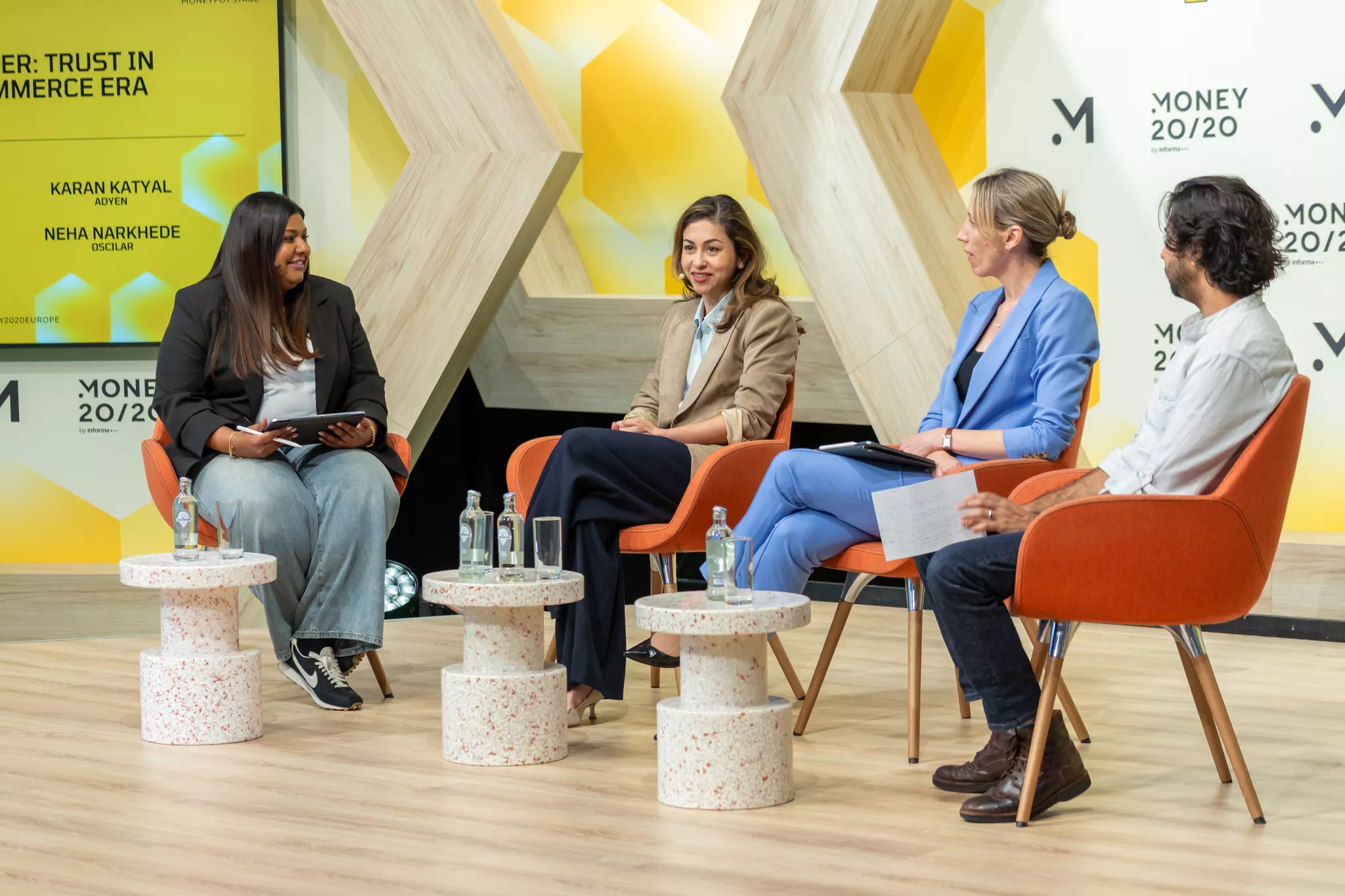
Neha opened on the assumption underneath decades of fraud work:
"For decades, the question behind fraud and identity was simple: is this a human or not? The absence of a human meant fraud. In an agent-driven world, the absence of a human can mean a perfectly legitimate agent."
— Neha Narkhede, co-founder and CEO, Oscilar
Nobody on stage pretended the fully autonomous future had already arrived, and that restraint made the conversation more useful. It stayed close to the ground. What actually breaks as agents move from demo to checkout? Each panelist pointed at a different potential fault line
For Karan, it was commerce readiness. Agent-led shopping is live, but cautious, mostly human-in-the-loop, where a person lets an assistant search and choose, then signs off before anything is bought. Fully autonomous and machine-to-machine flows are further out than the demos suggest. And the hardest part is not the payment. It is everything wrapped around it: merchant data, catalog depth, the post-purchase systems an agent has to reach into.
For Caroline, it was regulation. Agent-initiated payments are still edge cases, with delegated authority, authentication, and liability all unsettled. The internet, as she put it, was never built with an identity layer for agents to inherit.
For Neha, it was the risk system itself. Checking an agent once, at the front door, tells you nothing about the rest of the session. Agentic commerce turns trust into something continuous: who authorized this agent, what is it allowed to do, and is it still doing only that?
"We verify the agent's credentials and the scope of the mandate, and then we focus on drift monitoring, detecting the arc of agent behavior over a period of time."
— Neha Narkhede
For us, that is the moment the conversation stops being theoretical. Agentic commerce turns verification into an ongoing read on identity and intent, not a one-time check at the door.
"Was authorized" is not "is authorized"
Two gaps open up here. The first is detection. For years, "not human" was the gold standard of fraud detection. It is not anymore, not when a customer's own assistant is the non-human party, and the legitimate and the malicious arrive through the exact same automated door. Static rules and models retrained over months cannot keep up with adversaries that retool in hours. The better approach reads hundreds of signals at once, device, behavior, transaction history, because a fraudster can fake a few of them, but faking hundreds across a whole session is hard. The effort to pull that off becomes a signal in its own right.
The second gap is timing. A credential tells you an agent was authorized at setup. It tells you nothing about whether it is still inside its mandate ten minutes later, and a flag raised on one network may never reach the next. "Was authorized" is not "is authorized right now." Closing that gap means checking the agent, its mandate, and the person behind it continuously, and watching how it behaves through the session, not just waving it through at the start.
Then there is liability, which nobody has settled. Neha's example stuck with us. An agent reads a manipulated merchant listing and buys the wrong thing. The customer approved the agent. The merchant's page was poisoned. A third party wrote the agent. So who pays? The chargeback model, which sorts responsibility by who checked which credentials, is a place to start. It is not the whole answer.
Build in the open
On direction, the panel agreed: the trust infrastructure has to be built in the open. Easy to say, harder to live up to. The real test is whether networks, platforms, merchants, and agent builders can settle on enough shared plumbing before everyone's proprietary models harden. Karan made the case against closed loops, where each platform lays its own rail and keeps the value to itself, and pointed to real progress, like Google handing its AP2 agent-payments protocol to FIDO.
Caroline pushed from the regulatory side. The technical standards are still forming, the liability model even more so, and until both firm up, big institutions will be slow to put real volume through agent-led flows. Neha's answer was the most concrete: portable, verifiable agent identity with delegated authority, built on open standards. Make merchants wire up ten proprietary identity models for ten platforms, she warned, and the channel gets too heavy to ever really move. Interoperability, in her words, is non-negotiable.

At the booth, the questions were practical
Over three days, our EMEA team welcomed more hundreds of visitors: customers, partners, and a lot of new faces. Most came to talk about what is keeping them busy right now, fraud pressure, onboarding, AML, credit risk, and the constant push to move faster without breaking compliance.
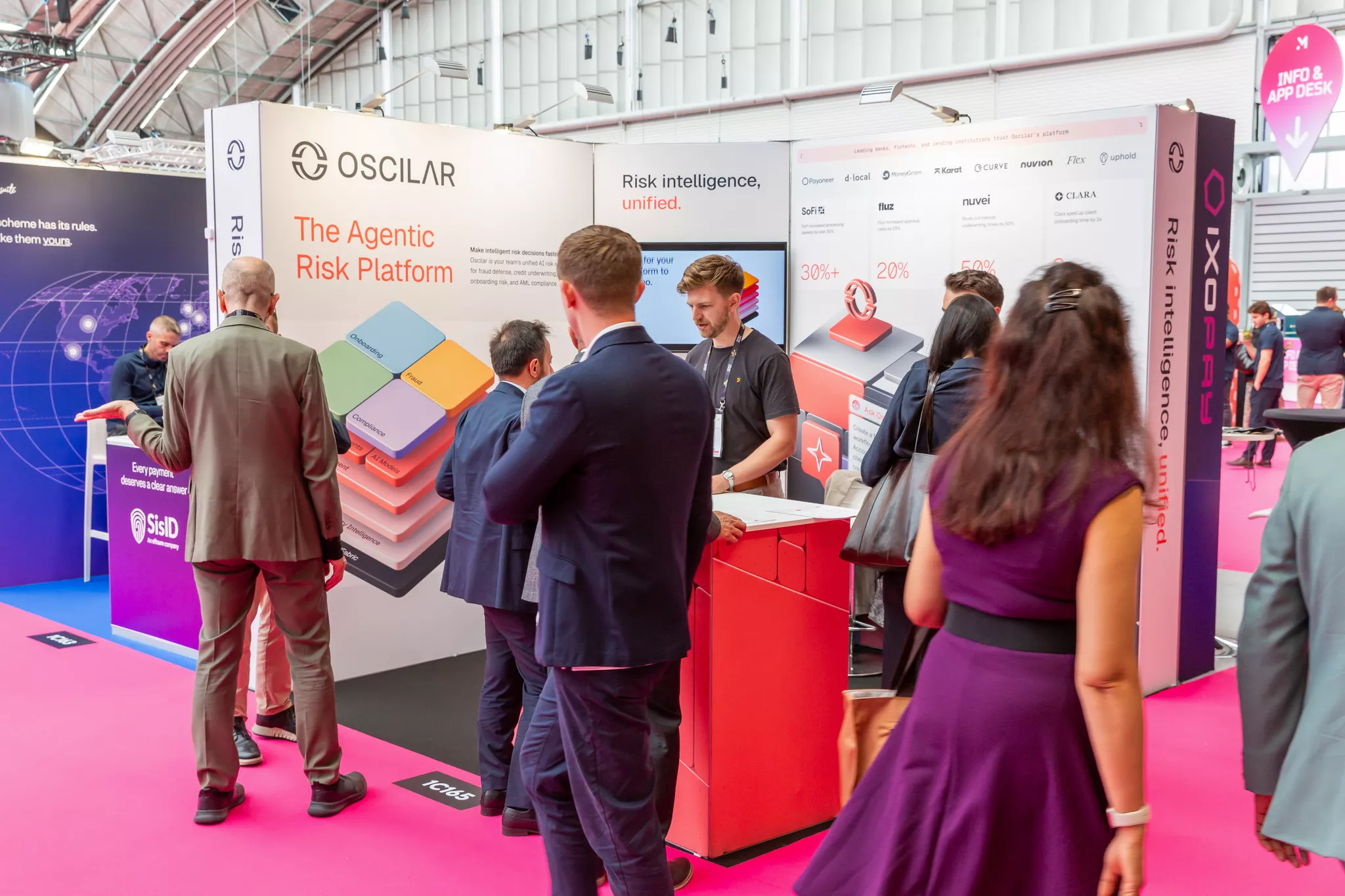
The word that came up again and again was control. More automation, yes, but not another black box nobody can explain after the fact, and not a shortcut that opens a new door for fraud. That is where agents kept entering the conversation. A year ago we barely heard about them.
This year, people asked specific things: could their fraud stack tell an approved agent from a bot? What happens when an agent's mandate shifts mid-session? Who eats the loss when an agent follows bad merchant data? The questions no longer sounded hypothetical.
Agents are the sharp edge
Agents were not the whole story at Money20/20. But they made the bigger shift impossible to miss: money is moving faster, more decisions are being automated, and trust is getting harder to verify in real time.
Faster account-to-account rails like Wero, open banking pushing into recurring payments, stablecoin settlement: all of it speeds money up and sends it through more automated hands, and every step makes it a little harder to know who, or what, you are dealing with while the money moves. Agents just make that impossible to ignore.
The volumes are still small today, but the decisions about how much fraud rides along with them are being made right now. What Neha argued on stage holds just as well for every conversation at the booth. Trust cannot be a gate an agent clears once. It has to travel with the agent and get checked across the whole session, built on portable, verifiable identity and open standards the industry can actually share. Agentic commerce will not scale on payment credentials alone, and the time to build that in is before the volume arrives, not after.

To everyone who found us in Amsterdam, the customers who swapped notes between sessions, the partners we work with, and the people we met for the first time at the booth and beyond: thank you. Those conversations are the reason we make the trip.
If your team is wrestling with agent identity, mandate enforcement, or risk controls for AI-led transactions, we would love to talk.

Oscilar Team
The Oscilar Team is comprised of experts from many domains of risk operations. These articles express viewpoints and knowledge from a variety of sources and contributors across the organization.
DISCLAIMER
The content on this website is provided for informational purposes only and does not constitute legal, tax, financial, investment, or other professional advice. Any views or opinions expressed by quoted individuals, contributors, or third parties are solely their own and do not necessarily reflect the views of our organization.
Nothing herein should be construed as an endorsement, recommendation, or approval of any particular strategy, product, service, or viewpoint. Readers should consult their own qualified advisors before making any financial or investment decisions.
Oscilar makes no representations or warranties as to the accuracy, completeness, or timeliness of the information provided and disclaims any liability for any loss or damage arising from reliance on this content. This website may contain links to third-party websites, which Oscilar does not control or endorse.






" height="48px" id="Qi9pnIQwR" width="48px"/></g></svg>)
" height="39.77194px" id="A8r2uGwai" transform="translate(2 3.808)" width="44px"/></svg>)


" height="22.301126233991734px" id="PeyDPUyWO" transform="translate(45.365 4.852)" width="20.043580159797898px"/><path d="M 13.46 11.116 C 12.368 10.493 10.888 9.973 9.024 9.556 C 7.664 9.236 6.613 8.927 5.887 8.624 C 5.155 8.321 4.647 7.979 4.355 7.59 C 4.064 7.201 3.921 6.704 3.921 6.104 C 3.921 5.184 4.269 4.447 4.972 3.898 C 5.675 3.349 6.624 3.069 7.83 3.069 C 8.79 3.069 9.607 3.241 10.282 3.578 C 10.951 3.921 11.482 4.401 11.876 5.018 C 12.265 5.641 12.511 6.361 12.614 7.184 L 16.1 6.973 C 15.94 5.63 15.523 4.435 14.854 3.383 C 14.185 2.332 13.265 1.503 12.105 0.903 C 10.945 0.303 9.539 0 7.899 0 C 6.355 0 5.024 0.263 3.904 0.783 C 2.783 1.303 1.92 2.035 1.32 2.978 C 0.72 3.921 0.417 5.001 0.417 6.224 C 0.417 7.344 0.646 8.281 1.109 9.036 C 1.572 9.785 2.315 10.419 3.349 10.928 C 4.384 11.436 5.755 11.905 7.481 12.328 C 9.024 12.688 10.19 13.059 10.985 13.442 C 11.774 13.825 12.311 14.237 12.591 14.688 C 12.871 15.14 13.014 15.666 13.014 16.266 C 13.014 16.906 12.848 17.455 12.517 17.906 C 12.185 18.358 11.705 18.695 11.076 18.912 C 10.448 19.135 9.676 19.243 8.779 19.243 C 7.739 19.243 6.847 19.072 6.104 18.735 C 5.361 18.392 4.778 17.883 4.344 17.203 C 3.915 16.523 3.629 15.689 3.486 14.711 L 0 14.923 C 0.103 16.403 0.514 17.7 1.246 18.798 C 1.977 19.901 2.972 20.764 4.235 21.381 C 5.498 22.004 6.99 22.313 8.71 22.313 C 10.27 22.313 11.636 22.061 12.797 21.564 C 13.957 21.061 14.871 20.341 15.528 19.398 C 16.191 18.455 16.523 17.346 16.523 16.06 C 16.523 15.02 16.289 14.094 15.814 13.282 C 15.346 12.471 14.563 11.756 13.471 11.133 Z" fill="rgb(20, 20, 20)" height="22.312556870217108px" id="ZaBOTiDLx" transform="translate(68.34 4.858)" width="16.522951309374434px"/><path d="M 13.682 17.877 C 12.751 18.792 11.442 19.243 9.762 19.243 C 8.522 19.243 7.43 18.923 6.504 18.283 C 5.572 17.643 4.847 16.723 4.326 15.517 C 3.806 14.317 3.543 12.871 3.543 11.191 C 3.543 9.51 3.801 8.093 4.309 6.876 C 4.818 5.664 5.544 4.727 6.487 4.064 C 7.43 3.401 8.533 3.069 9.79 3.069 C 11.373 3.069 12.619 3.486 13.534 4.315 C 14.443 5.149 15.031 6.281 15.294 7.727 L 18.901 7.544 C 18.438 5.178 17.472 3.332 16.003 2 C 14.528 0.669 12.459 0 9.796 0 C 7.83 0 6.115 0.457 4.641 1.366 C 3.166 2.28 2.029 3.572 1.217 5.241 C 0.406 6.916 0 8.893 0 11.179 C 0 13.465 0.412 15.494 1.235 17.146 C 2.058 18.798 3.201 20.072 4.675 20.964 C 6.15 21.855 7.847 22.301 9.767 22.301 C 11.528 22.301 13.054 21.975 14.334 21.324 C 15.614 20.672 16.654 19.752 17.443 18.558 C 18.232 17.363 18.758 15.957 19.021 14.334 L 15.443 14.151 C 15.203 15.711 14.614 16.952 13.682 17.86 Z" fill="rgb(20, 20, 20)" height="22.301126257066386px" id="dj2F9fN0f" transform="translate(87.772 4.841)" width="19.020540282808156px"/><path d="M 0 21.335 L 0 0 L 3.423 0 L 3.423 21.335 Z" fill="rgb(20, 20, 20)" height="21.335239445830055px" id="fvIs54YbW" transform="translate(110.485 5.332)" width="3.423468638642248px"/><path d="M 3.429 0 L 0 0 L 0 21.341 L 13.762 21.341 L 13.762 18.272 L 3.429 18.272 Z" fill="rgb(20, 20, 20)" height="21.340954752405395px" id="KykvynROU" transform="translate(118.389 5.332)" width="13.762458233473922px"/><path d="M 9.859 3.303 L 16.077 21.335 L 19.684 21.335 L 11.991 0 L 7.693 0 L 0 21.335 L 3.635 21.335 L 9.853 3.303 Z" fill="rgb(20, 20, 20)" height="21.33523944583004px" id="Ln_a1JZTX" transform="translate(133.986 5.338)" width="19.683515845550573px"/><path d="M 11.545 12.499 C 12.968 12.059 14.043 11.322 14.774 10.293 C 15.506 9.259 15.871 8.024 15.871 6.584 C 15.871 4.521 15.191 2.909 13.825 1.743 C 12.465 0.583 10.539 0 8.053 0 L 0 0 L 0 21.335 L 3.423 21.335 L 3.423 13.071 L 8.201 13.071 L 12.802 21.335 L 16.529 21.335 L 11.539 12.499 Z M 11.173 9.116 C 10.402 9.705 9.327 10.002 7.944 10.002 L 3.435 10.002 L 3.435 3.058 L 7.944 3.058 C 9.327 3.058 10.402 3.361 11.173 3.961 C 11.945 4.561 12.328 5.435 12.328 6.573 C 12.328 7.71 11.945 8.522 11.173 9.11 Z" fill="rgb(20, 20, 20)" height="21.335239490803623px" id="Qt9AxOqZR" transform="translate(156.099 5.338)" width="16.528666547835087px"/><path d="M 33.9 0.006 L 25.607 0.006 C 25.213 0.006 24.875 0.291 24.818 0.674 C 24.687 1.555 24.47 2.4 24.19 3.201 C 23.224 5.978 21.44 8.27 19.194 9.682 L 19.217 9.682 C 19.217 9.682 25.453 9.522 27.539 3.201 L 27.539 3.201 L 30.859 3.201 C 29.482 7.161 26.459 10.133 22.778 10.968 C 22.098 11.122 21.4 11.202 20.68 11.202 C 19.514 11.202 18.394 10.991 17.343 10.596 C 14.233 9.436 11.719 6.698 10.501 3.195 C 10.216 2.389 10.004 1.543 9.873 0.669 C 9.816 0.28 9.478 0 9.084 0 L 0.803 0 C 0.317 0 -0.061 0.434 0.008 0.914 C 0.117 1.697 0.277 2.458 0.488 3.201 C 2.3 9.687 7.672 14.397 14.005 14.403 C 10.924 13.357 6.106 10.436 3.837 3.201 L 3.837 3.201 L 3.837 3.201 L 7.158 3.201 C 8.027 6.298 9.707 9.002 11.919 10.968 C 13.496 12.374 15.342 13.408 17.354 13.957 C 18.423 14.248 19.543 14.403 20.692 14.403 C 27.03 14.403 32.408 9.687 34.22 3.201 C 34.426 2.463 34.586 1.697 34.7 0.914 C 34.769 0.434 34.391 0 33.906 0 Z" fill="rgb(20, 20, 20)" height="14.402572631835938px" id="yxyckXN6_" transform="translate(0 17.597)" width="34.708059114564385px"/><path d="M 0.803 14.403 L 9.095 14.403 C 9.49 14.403 9.827 14.117 9.884 13.734 C 10.016 12.854 10.233 12.008 10.513 11.208 C 11.479 8.43 13.256 6.138 15.497 4.727 L 15.479 4.727 C 15.479 4.727 9.244 4.887 7.158 11.208 L 7.158 11.208 L 3.837 11.208 L 3.837 11.208 C 5.209 7.247 8.238 4.269 11.913 3.435 C 12.593 3.281 13.29 3.201 14.011 3.201 C 15.176 3.201 16.297 3.412 17.348 3.806 C 20.457 4.967 22.972 7.704 24.19 11.208 L 24.19 11.208 L 24.19 11.208 C 24.475 12.014 24.687 12.859 24.818 13.734 C 24.875 14.123 25.213 14.403 25.607 14.403 L 33.9 14.403 C 34.386 14.403 34.763 13.968 34.694 13.488 C 34.586 12.711 34.426 11.945 34.214 11.202 C 32.408 4.721 27.024 0 20.686 0 C 23.767 1.046 28.59 3.961 30.865 11.208 L 30.865 11.208 L 27.544 11.208 L 27.544 11.208 L 27.544 11.208 C 26.681 8.104 24.995 5.407 22.784 3.435 C 21.206 2.029 19.36 1 17.354 0.446 C 16.28 0.154 15.165 0 14.016 0 C 7.672 0 2.294 4.721 0.488 11.208 L 0.488 11.208 L 0.488 11.208 C 0.282 11.951 0.122 12.711 0.008 13.494 C -0.061 13.974 0.317 14.408 0.803 14.408 Z" fill="rgb(20, 20, 20)" height="14.408287876490093px" id="fJajgayao" width="34.70234380798904px"/></g></svg>)