
Última atualização: janeiro de 2026
Os líderes de tecnologia bancária encontram-se em um dilema familiar: a McKinsey estima que a IA pode adicionar de US$ 200 bilhões a US$ 340 bilhões em valor anual ao setor bancário global, o equivalente a 9 a 15 por cento dos lucros operacionais. A visão da consultoria sobre um Banco de IA do Futuro é atraente: tomada de decisões em tempo real, agentes autônomos, serviço hiperpersonalizado. No entanto, de acordo com um estudo do MIT de agosto de 2025, 95% dos projetos-piloto de IA em empresas não conseguem entregar nenhum impacto financeiro mensurável. A maioria dos bancos está presa no que o setor passou a chamar de "purgatório de pilotos", realizando dezenas de testes isolados que nunca ganham escala.
O senso comum diz que a única saída é a transformação de "substituição total": remover o núcleo legado, reconstruir do zero, aceitar ciclos de compras de 18 meses e orçamentos de oito dígitos. Mas esta narrativa é paralisante e incorreta.
Existe um caminho diferente. Os bancos podem capturar de 70 a 80 por cento do valor potencial da IA concentrando-se em um pequeno número de subdomínios de alto impacto e implantando uma infraestrutura de IA moderna em conjunto com os sistemas legados — em vez de tentar substituições completas do núcleo que levam vários anos.
Este texto analisa esse caminho. Baseia-se no framework do Banco de IA do Futuro da McKinsey & Company, que posiciona a IA como uma infraestrutura horizontal que abrange o engajamento do cliente, a tomada de decisões, a tecnologia essencial e os modelos operacionais. Considerando esse modelo como ponto de partida, o foco aqui é a execução: como os bancos podem operacionalizar essa visão sob escrutínio regulatório real, limitações de sistemas legados e requisitos de gestão de riscos.
Profissionais com ampla experiência na construção de sistemas de dados em tempo real em grandes instituições financeiras observam consistentemente a mesma lacuna: embora os bancos tenham investido muito para mover dados de forma mais rápida, eles falharam em modernizar como as decisões de risco são tomadas assim que esses dados chegam. O resultado é uma proliferação de ferramentas isoladas, pipelines frágeis e processos humanos lentos — precisamente no momento em que os fraudadores estão coordenando ataques em toda a jornada do cliente.
Resumo rápido
Os bancos estão presos no “purgatório de pilotos”. A adoção de IA desacelera porque a tomada de decisões de risco continua isolada, as compras são lentas e os modelos de governança foram criados para sistemas determinísticos (e não de agentes autónomos).
Não é necessário substituir o sistema principal. Os bancos podem capturar de 70% a 80% do valor da IA ao aplicar uma plataforma de decisão unificada e em tempo real sobre os sistemas legados.
O retorno sobre o investimento mais rápido está na camada de decisão. Casos de uso de fraude, PLD (prevenção à lavagem de dinheiro), crédito e conformidade — especialmente modo shadow, agentes de assistência ao analista e sobreposições de PLD — trazem ganhos rápidos e de baixo risco.
O progresso vem de “soluções graduais viáveis”. Implantações pequenas e contidas operando ao lado de sistemas existentes permitem que os bancos comprovem valor, atendam à gestão de risco de modelos e cresçam com segurança.
A governança acelera a adoção. Explicabilidade, controles com supervisão humana, trilhas de auditoria e torres de controle de IA possibilitam uma implantação mais rápida e em total conformidade.
Parte I: O Contexto Estratégico
Por que os sistemas legados não conseguem acompanhar o ritmo
O banco típico de grande porte opera com uma infraestrutura projetada para outra época. Os dados dos clientes estão fragmentados em silos: bancos de dados separados para cartões de crédito, hipotecas, poupança e gestão de patrimônio. Criar uma visão em tempo real e de 360 graus de qualquer cliente exige a conexão de sistemas que nunca foram feitos para se comunicar. A lógica de decisão geralmente está programada diretamente em mainframes ou trancada em "caixas-pretas" de fornecedores, transformando até mesmo simples mudanças de regras em um esforço de engenharia de várias semanas. Na prática, isso geralmente significa que um cliente pode falhar na verificação de identidade durante o cadastro e, ainda assim, ser aprovado para crédito ou pagamentos instantâneos minutos depois — simplesmente porque esses sistemas nunca compartilham sinais.
Essa arquitetura foi otimizada para manter a estabilidade em um mundo onde as fraudes ocorriam em velocidade humana. Hoje, os invasores testam fluxos de cadastro, verificam meios de pagamento e exploram sistemas de crédito em sequências coordenadas — muitas vezes em questão de minutos. O serviço FedNow, que hoje conta com mais de 1.400 instituições financeiras participantes, e as redes de stablecoin exigem liquidação instantânea. Os fraudadores usam IA generativa para lançar ataques na velocidade das máquinas. Os clientes esperam do seu banco a mesma agilidade que recebem do seu serviço de streaming. Um sistema que é atualizado apenas de um dia para o outro não consegue se defender contra ameaças que evoluem em minutos.
Quando os sistemas de risco operam de forma independente, cada um vê apenas um fragmento do ataque. O que parece inofensivo isoladamente torna-se óbvio apenas quando os sinais são avaliados em conjunto e em tempo real.
O modelo da McKinsey
O modelo Banco de IA do Futuro da McKinsey propõe tratar a IA não como um conjunto de casos de uso isolados, mas como uma infraestrutura horizontal que abrange quatro camadas da organização: Engajamento, Decisão, Tecnologia e Dados Essenciais, e Modelo Operacional.
O modelo está na direção certa. O desafio enfrentado pelos bancos não é compreender o destino final, mas sim contornar as restrições — aprovação regulatória, gestão de risco de modelos, integração com sistemas legados e segurança operacional — necessárias para alcançá-lo.
A Camada de Engajamento lida com as interfaces voltadas para o cliente: interações multimodais por voz, texto e imagem, apoiadas por "gêmeos digitais" que simulam o comportamento do cliente e permitem um atendimento personalizado e proativo. A camada de decisão é onde os dados se transformam em ação: agentes de IA e copilotos realizam raciocínios em tempo real, orquestram processos complexos e alcançam ganhos de produtividade que a McKinsey projeta entre 20 e 60 por cento. A Camada de Tecnologia e Dados Essenciais fornece a base: arquiteturas de dados unificadas que eliminam silos, bancos de dados vetoriais que permitem buscas semânticas em dados não estruturados e pipelines de LLM para gerenciar o ciclo de vida dos modelos. A Camada de Modelo Operacional organiza as pessoas: equipes multifuncionais, "torres de controle" de IA para governança e estruturas de responsabilidade focadas em resultados, em vez de apenas na conclusão do projeto.
O modelo é coerente. O problema é a execução.
Por que os bancos paralisam
Os líderes bancários enfrentam três barreiras estruturais ao tentarem passar da visão para a implementação. Uma pesquisa do BCG revelou que apenas 25% das instituições integraram capacidades de IA em seu plano estratégico — os outros 75% continuam presos em pilotos isolados e provas de conceito.
A primeira barreira é a aquisição. A expressão “infraestrutura de IA” geralmente dá início a ciclos de compras de 18 meses que envolvem compras, jurídico e conformidade. Em um cenário tecnológico que evolui tão rápido, as soluções escolhidas no início desses processos podem estar obsoletas no momento da implantação. Muitas instituições tentam compensar isso desenvolvendo pipelines personalizados internamente — montando estruturas complexas de transmissão, regras e análises que exigem grandes equipes de engenharia apenas para continuar funcionando. Para a maioria dos bancos, essa abordagem é economicamente insustentável.
A segunda é a governança. As estruturas de Gestão de Risco de Modelos foram desenhadas para modelos estáticos e determinísticos. Sistemas generativos e de agentes introduzem comportamentos probabilísticos que precisam ser controlados continuamente — por meio de explicabilidade, linhagem e monitoramento de desempenho em tempo real — em vez de aprovações únicas.
A terceira é o controle. Os bancos são compreensivelmente céticos em relação a propostas de "transformação" que exigem a terceirização da lógica de decisão para parceiros externos. Suas políticas de risco e percepções de clientes são propriedade intelectual. Ceder o controle dessa lógica a fornecedores inverte a proposta de valor.
Essas barreiras explicam a lacuna entre o entusiasmo e a ação. A solução está em reestruturar a tarefa: não como uma transformação total, mas como uma série de implantações contidas que provam seu valor e desenvolvem a capacidade institucional.
A escala da transformação que se aproxima
O que está em jogo está se tornando mais claro. Um relatório do Citigroup constatou que 54% dos empregos no setor bancário têm alto potencial de automação, com outros 12% que poderiam ser aprimorados por IA. De acordo com a Bloomberg Intelligence, os bancos globais eliminarão até 200.000 empregos nos próximos três a cinco anos à medida que a IA avança sobre tarefas atualmente realizadas por profissionais humanos. O DBS Bank de Cingapura já anunciou planos para reduzir sua força de trabalho em 4.000 cargos ao longo de três anos à medida que a IA assume funções, ao mesmo tempo em que implanta mais de 800 modelos de IA em 350 casos de uso.
No entanto, a pesquisa da Accenture sugere que a oportunidade supera a disrupção: a produtividade pode aumentar de 20 a 30 por cento e as receitas em 6 por cento para os bancos que implementarem a tecnologia de forma eficaz. A questão não é se devemos transformar, mas sim como fazê-lo sem prejudicar a estabilidade operacional.
Parte II: Cinco Soluções Graduais Viáveis
O framework da McKinsey define como é um banco que prioriza a IA. O que ele não prescreve é como as instituições reguladas podem caminhar em direção a esse futuro de forma gradual — sem expor clientes, reguladores ou balanços a riscos inaceitáveis. As “soluções graduais viáveis” a seguir refletem padrões de execução observados em implantações reais, onde os bancos comprovaram o valor primeiro para depois crescer com segurança.
As “soluções graduais viáveis” a seguir são padrões de execução observados em implantações reais que permitem que os bancos avancem em direção ao Banco de IA do Futuro de forma incremental.
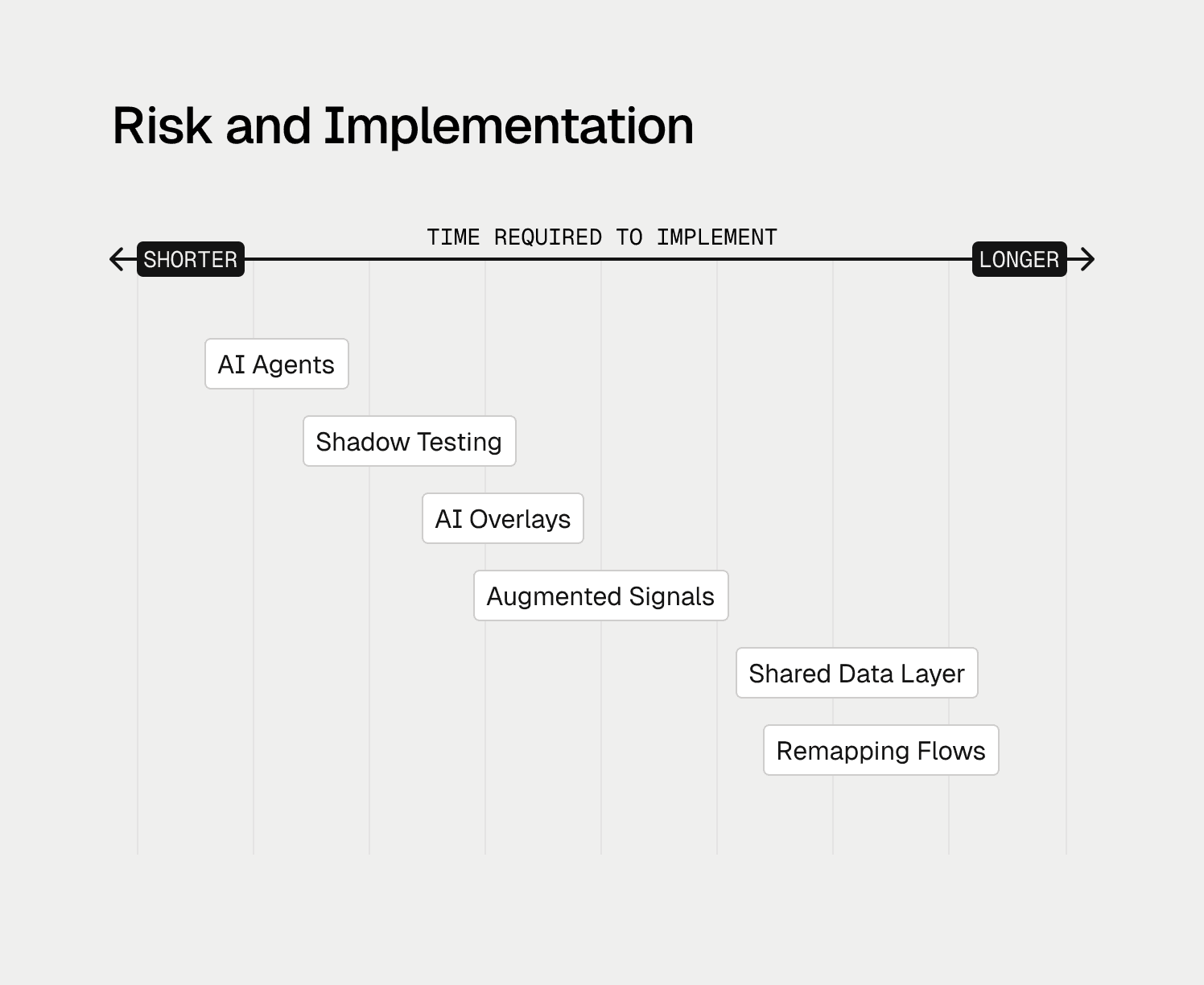
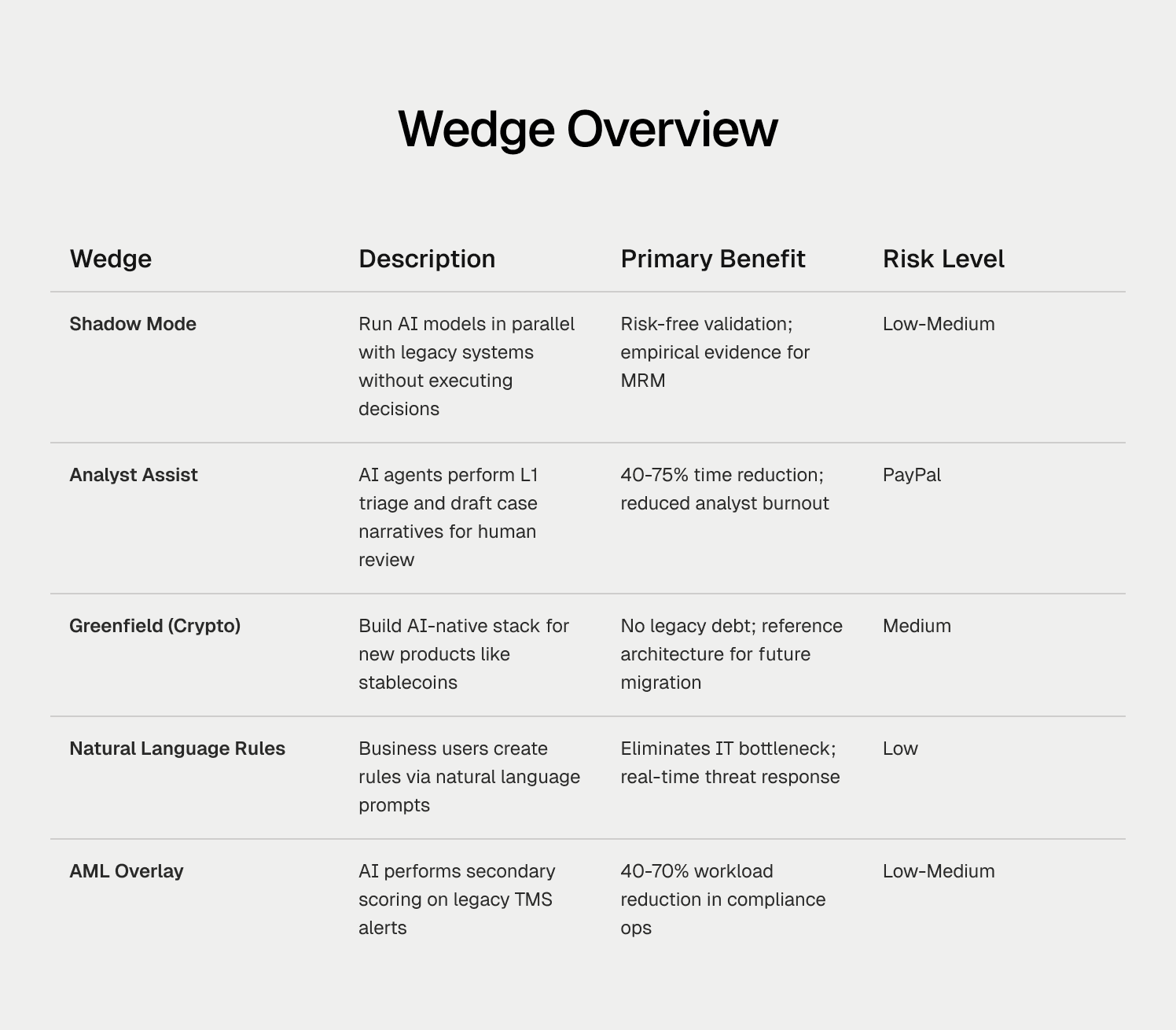
Uma solução gradual é uma implementação focada que introduz uma infraestrutura moderna de IA junto a sistemas legados, sem exigir uma substituição total. As cinco soluções a seguir oferecem diferentes perfis de risco e aplicabilidade imediata para líderes de risco e conformidade.
Solução 1: Decisão em modo shadow
O problema: Os bancos hesitam em implantar novos modelos de IA diretamente em produção porque o custo do erro é alto. Um falso positivo bloqueia um cliente legítimo. Um falso negativo permite uma fraude. Qualquer um dos resultados gera escrutínio regulatório e perda de clientes.
A solução: O modo shadow executa um novo mecanismo de decisão baseado em IA em paralelo com o sistema legado. Ambos os sistemas recebem os mesmos dados de produção em tempo real. Ambos tomam decisões. No entanto, apenas as decisões do sistema legado são executadas. As decisões do sistema de IA são registradas apenas para fins de comparação.
Como funciona: Os fluxos de dados de transações e clientes são duplicados, geralmente via gateways de API ou plataformas de streaming de eventos como o Kafka. Um fluxo alimenta o mecanismo de regras legado; o outro alimenta a plataforma de IA. Os analistas de risco comparam as decisões com os resultados reais. Quando o sistema de IA detecta um esquema de fraude que o sistema legado deixou passar, isso é uma prova de eficiência. Se o sistema de IA bloquear um cliente legítimo, isso é uma oportunidade de ajuste.
Por que funciona: O modo shadow é, na prática, um teste retrospectivo e prospectivo com dados reais e sem nenhum risco de produção. Ele gera o histórico empírico que os comitês de Gestão de Risco de Modelos exigem. Assim que o sistema de IA superar o legado de forma consistente, o banco pode fazer a transição ou direcionar o fluxo aos poucos por meio de uma implantação em fases (canary deployment). Com a mesma importância, possibilita a validação contínua. As equipes de risco conseguem medir falsos positivos, falsos negativos e desvios ao longo do tempo — alinhando-se muito mais à forma como os reguladores esperam que os sistemas de IA sejam controlados.
Nível de Risco: Baixo. Nenhum impacto para o cliente até que o banco opte por agir com base nas evidências coletadas.
Solução 2: Agentes de assistência ao analista (Triagem L1)
O problema: As equipes de risco e conformidade passam a maior parte do tempo em tarefas mecânicas — reunindo dados, alternando painéis e descartando falsos positivos óbvios em vez de aplicar análise crítica. Os sistemas legados de monitoramento de transações geram taxas de falsos positivos que superam 90 a 95 por cento. Os custos globais de conformidade com PLD ultrapassam agora os US$ 274 bilhões anuais, com grande parte disso destinada a lidar com alertas de baixa qualidade em vez de capturar criminosos. Os analistas passam a maior parte do tempo na triagem de Nível 1: coletando dados, copiando informações entre telas e descartando alarmes falsos evidentes.
A solução: Implantar agentes de IA para realizar a coleta de dados e a análise preliminar. O agente não substitui o analista; ele organiza o caso.
Como funciona: Quando um alerta é disparado, um "Agente de Investigação" consulta automaticamente bancos de dados internos, listas de observação externas e fontes públicas relevantes. Ele sintetiza os achados em um relatório contextualizado em linguagem natural que explica por que o alerta foi gerado e recomenda uma resolução. O analista revisa o material preparado em vez de começar a análise do zero.
Por que funciona: Estudos de caso indicam que essa abordagem reduz o tempo de revisão manual em 75% e permite que analistas juniores atuem em níveis seniores. O fator humano permanece no processo para a tomada de decisão final, o que mantém a governança enquanto otimiza a eficiência. As implantações mais eficazes tratam a IA como uma camada de suporte. Os agentes reúnem o contexto, priorizam os alertas e rascunham as justificativas — mas os humanos mantêm o poder de decisão, apoiados por trilhas de auditoria completas e explicações claras.
Nível de risco: Baixo a Médio. Os humanos mantêm a autoridade de decisão; a IA lida com a agregação de dados.
Solução 3: Produtos greenfield (stablecoins e criptomoedas)
O problema: Os bancos que entram no mercado de stablecoins, depósitos tokenizados ou custódia de criptoativos enfrentam uma incompatibilidade de tempo. Esses ativos funcionam em redes de blockchain que operam 24 horas por dia, 7 dias por semana, com liquidação instantânea. A Lei GENIUS, sancionada em julho de 2025, estabeleceu a primeira estrutura regulatória federal para stablecoins de pagamento, exigindo que as agências bancárias federais adotem regras abrangentes até julho de 2026. Os sistemas tradicionais de risco bancário, projetados para liquidação em D+2, não conseguem gerenciar riscos na velocidade da blockchain.
A solução: Desenvolver uma estrutura de risco nativa em IA especificamente para novas linhas de produtos. Como se trata de implantações do tipo greenfield, não há um sistema legado para substituir.
Como funciona: Implementar uma plataforma capaz de tomar decisões em menos de 100 milissegundos para acompanhar a velocidade da blockchain. Integrar tanto dados fiduciários tradicionais (KYC, transferências bancárias) quanto dados on-chain (endereços de carteiras, gráficos de transações) para detectar redes de lavagem de dinheiro que conectam esses dois mundos. Utilizar agentes de IA para aplicar regras automaticamente, como o bloqueio de transferências para endereços de carteiras sob sanção em tempo real.
Por que funciona: Novos produtos oferecem "segurança desde a concepção". O sucesso do projeto cria uma arquitetura de referência e conhecimento interno que fortalecem o argumento para migrar as linhas de negócios legadas para uma infraestrutura moderna.
Nível de risco: Médio. Risco associado ao novo produto, mas sem o risco de migração de sistemas legados.
Solução 4: Conversão de linguagem natural em regras
O problema: Nos bancos tradicionais, alterar uma regra de risco exige que um analista documente a lógica, envie para a equipe de TI, aguarde um ciclo de desenvolvimento e depois espere pelos testes. Essa tradução entre a intenção de negócio e o código leva dias ou semanas. Os fraudadores mudam de tática em minutos.
A solução: Plataformas de IA modernas permitem que usuários não técnicos criem e testem regras utilizando linguagem natural. Um profissional de risco digita: "Sinalizar todas as transações acima de US$ 5.000 originadas de IPs em jurisdições de alto risco se a conta tiver menos de 30 dias de criação." A IA traduz isso em lógica executável.
Como funciona: O profissional de risco insere o objetivo da política por meio de uma interface de chat. O agente de IA generativa traduz essa instrução em código de decisão. O agente executa imediatamente uma simulação (usando o modo shadow) para demonstrar o impacto em dados históricos: "Esta regra teria detectado 50 casos de fraude, mas gerado 200 falsos positivos na semana passada." Uma vez validada, a regra é implantada em produção, sujeita à aprovação de governança.
Por que funciona: Eliminar o gargalo da TI permite que as equipes de risco reajam a ameaças em tempo real. As equipes de negócios ganham controle direto sobre suas ferramentas, mantendo-se dentro das diretrizes de governança.
Nível de risco: Baixo com a governança adequada. A simulação evita a implantação de regras mal ajustadas.
Solução 5: Redução de falsos positivos em PLD
O problema: A Prevenção à Lavagem de Dinheiro (PLD) costuma ser a função de conformidade mais cara e menos eficiente. Sistemas de monitoramento de transações baseados em regras ("sinalizar qualquer depósito em dinheiro acima de US$ 10 mil") geram filas imensas de alertas, com taxas de falsos positivos entre 95 e 98 por cento.
A solução: Implantar uma "camada de sobreposição" de IA que realiza uma análise secundária nos alertas gerados pelo sistema legado. O sistema principal de monitoramento de transações permanece inalterado.
Como funciona: O sistema legado gera alertas com base em regras regulatórias. Esses alertas são direcionados a um agente de IA que analisa milhares de variáveis adicionais: padrões de comportamento, conexões de rede, IDs de dispositivos. A IA identifica alertas que são claramente falsos positivos e os encerra automaticamente, gerando uma justificativa documentada para fins de auditoria. Apenas os alertas de alto risco chegam aos analistas humanos. O impacto vem menos de algoritmos inéditos e mais do contexto. Quando os sinais de cadastro, comportamento, transações e redes são avaliados em conjunto, os padrões que antes eram invisíveis tornam-se claros.
Por que funciona: Trata-se de um suporte puro, sem necessidade de substituição do sistema principal. Referências do setor apontam para uma redução de 40 a 70 por cento no trabalho manual. O cálculo do retorno sobre o investimento é simples o suficiente para passar pela análise do CFO.
Nível de risco: Baixo a Médio. Requer documentação com padrão de auditoria para justificar o encerramento automático dos alertas.
Parte III: Evidências de campo
Na última década, as instituições financeiras investiram muito em infraestruturas de dados em tempo real — transmissão de eventos, APIs e pipelines mais velozes. No entanto, muitas se depararam com a mesma limitação: embora os dados chegassem cada vez mais em tempo real, as decisões de risco geralmente não acompanhavam essa velocidade.
As equipes acumularam sistemas fragmentados, cada um otimizado isoladamente. Algumas tentaram construir camadas de decisão customizadas sobre estruturas modernas de dados, apenas para descobrir que manter a precisão, a explicabilidade e a conformidade em escala exigia muito mais esforço de engenharia do que o previsto.
Isso não foi exclusividade dos bancos. As fintechs enfrentaram fragmentação e taxas de falsos positivos semelhantes. A diferença estava nas limitações operacionais. As fintechs eram frequentemente forçadas a agir rápido porque a ineficiência se traduzia imediatamente em perdas financeiras ou atrito com o cliente. Os bancos operavam sob exigências mais rígidas de estabilidade, auditabilidade e segurança regulatória.
O que surge é um cenário mais claro de onde a IA gera valor real hoje: processos de decisão internos — detecção de fraudes, triagem de PLD e processamento de documentos. Isso traz resultados mensuráveis porque as entregas podem ser validadas, revisadas e aprimoradas continuamente. Em contrapartida, os sistemas de IA voltados diretamente para o cliente ou que tomam decisões financeiras irreversíveis exigem maior cautela e controles mais rígidos.
Os exemplos abaixo refletem o que observamos nas implementações da plataforma de decisão de risco por IA da Oscilar, ilustrando como as instituições aplicaram essas lições na prática — adotando processos de decisão unificados e supervisão humana de forma incremental para obter agilidade sem assumir riscos operacionais ou regulatórios adicionais.
MoneyGram, SoFi e Nuvei: Consolidando decisões sob governança
A MoneyGram, a SoFi e a Nuvei ilustram uma limitação comum em larga escala: mesmo com uma infraestrutura de dados moderna, a tomada de decisões de risco muitas vezes fica atrás da velocidade de movimentação do dinheiro.
A MoneyGram opera uma rede global de pagamentos que abrange milhares de rotas e jurisdições. À medida que expandiu para liquidação instantânea e ativos digitais, os sistemas de risco focados em lotes (batch) tornaram-se cada vez mais difíceis de adaptar.
Em vez de substituir os sistemas existentes, a MoneyGram consolidou as decisões de fraude, PLD e cadastro de clientes em uma única camada de decisão. Novas regras e modelos foram avaliados em modo shadow junto aos controles existentes, permitindo que as equipes medissem o impacto em dados reais antes de qualquer alteração em produção. Isso permitiu decisões em tempo real adequadas para iniciativas de stablecoins, preservando a disciplina operacional. As equipes relataram uma redução de até 70% no tempo de migração de dados e a capacidade de evoluir a lógica de risco continuamente sem interromper as operações de produção.
A SoFi encontrou uma dinâmica semelhante a partir de um ponto de partida diferente. Operando em áreas como empréstimos, fraudes e cobranças, as mudanças de políticas dependiam frequentemente de filas de engenharia e ferramentas fragmentadas. Ao centralizar a lógica de decisão e permitir testes controlados, a SoFi reduziu o tempo de lançamento de novas estratégias de risco em cerca de 50% e melhorou a velocidade de processamento em mais de 30%, mantendo uma supervisão consistente em todos os produtos.
Em ambientes de pagamentos como o da Nuvei, essa mesma arquitetura apoia decisões de risco integradas sob restrições rígidas de latência, onde o custo do erro é imediato — seja como perda por fraude ou atrito com o cliente —, tornando essenciais os testes em modo shadow e caminhos claros de escalonamento. Como observou Daniel Hough, Diretor de Risco e Subscrição na Nuvei: “Nossa solução anterior simplesmente não oferecia as funcionalidades avançadas de que precisávamos: IA, automação ou ferramentas para fazer recomendações complexas além de conjuntos de regras básicos. A Oscilar nos dá a flexibilidade e a inteligência para gerenciar nossa carteira de formas totalmente novas, e isso é muito importante para nós.”
A lição: unificar a tomada de decisões, validar a precisão com supervisão humana e, em seguida, expandir o escopo.
Flexcar, Dibsy e Fluz: Reduzindo falsos positivos por meio de contexto compartilhado
Nas implantações com a Flexcar, Dibsy e Fluz, problemas semelhantes surgiram logo no início: alto índice de falsos positivos, acúmulo de análises manuais e sinais de risco desconectados. As melhorias vieram da avaliação conjunta de sinais e da aceleração dos ciclos de feedback, mantendo a responsabilidade humana.
A Flexcar reduziu suas taxas de risco pela metade e zerou as perdas de ativos ao coordenar verificações de identidade, comportamento e transações em um único fluxo de decisão, com revisores humanos acompanhando os casos complexos.
A Dibsy obteve uma redução de aproximadamente 80% nas fraudes ao mesmo tempo em que acelerou em cinco vezes o cadastro de lojistas, avaliando o risco de cadastro e transações de forma holística em vez de usar ferramentas separadas.
A Fluz reduziu as revisões manuais em cerca de 90% e aumentou as taxas de aprovação em cerca de 20%, transferindo a triagem de alertas e a coleta de contexto para fluxos automatizados, mantendo as decisões finais com revisores humanos.
Esses resultados mostram onde a IA tem o melhor desempenho: em decisões internas e no suporte a analistas, onde os resultados podem ser medidos, auditados e aprimorados de forma contínua.
Clara, Cashco e Parker: Autonomia para equipes de risco sem dependência de TI
Nas operações de subscrição e conformidade, os atrasos costumam ser causados menos pela qualidade do modelo e mais pelas longas filas de desenvolvimento de software. Alterações na lógica de decisão podem levar semanas, limitando a capacidade de resposta às condições do mercado.
As implantações com a Clara, a Cashco e a Parker mostram como essa limitação pode ser resolvida sem perder o controle. Ao permitir que as equipes de risco configurem, testem e adaptem a lógica de decisão diretamente — dentro de limites controlados e com trilhas de auditoria completas —, as organizações reduziram significativamente os ciclos de ajuste.
A Clara relatou um processo de cadastro 3 vezes mais rápido, capacidade de processamento de 3 a 4 vezes maior sem contratação de pessoal e desempenho consistente em acordos de nível de serviço (SLA) durante períodos de crescimento. A Cashco e a Parker observaram efeitos semelhantes: implantações de subscrição em dias em vez de semanas, redução de cerca de 70% nas pendências e tempos de processamento cerca de 40% mais rápidos.
Para os bancos, esse padrão diminui a dependência de recursos escassos de engenharia de software, preservando a explicabilidade e o controle.
TransPecos Banks: Modernização gradual sob supervisão regulatória
O TransPecos Banks, um banco comunitário centenário que atende a múltiplos parceiros de Banking-as-a-Service, enfrentava uma complexidade crescente em PLD sem a possibilidade de aumentar sua equipe ou sua exposição regulatória.
Em vez de substituir seus sistemas centrais, o TransPecos centralizou as decisões de PLD e a gestão de casos, mantendo os controles existentes. A triagem de alertas, investigações e elaboração de relatórios de atividade suspeita (SAR) foram unificadas, com profissionais mantendo o poder de decisão final sobre cada envio de relatório.
O impacto operacional incluiu:
Redução de 40% nos custos das operações de PLD
Redução de 70% no tempo de análise de alertas
Redução de 80% no tempo de gestão de relatórios de atividade suspeita (SAR)
Mais de US$ 3 milhões em economia anual projetada
Igualmente importante foi o impacto durante as auditorias regulatórias. As equipes demonstraram trilhas de auditoria completas e rastreabilidade de dados — do alerta ao envio do relatório — em um único sistema, eliminando a conciliação manual entre várias ferramentas diferentes.
Um auditor observou: "Esta é a supervisão de gestão de riscos mais clara que já vimos em um banco do seu porte." Quando a IA realiza o trabalho mecânico com documentação completa e os humanos mantêm o julgamento nas decisões críticas, a conformidade torna-se mais segura e menos complexa.
O que essas implantações revelam
Em redes globais, fintechs e bancos comunitários, surgem padrões consistentes:
A IA entrega valor imediato na detecção de fraudes, triagem de PLD e processamento de documentos — áreas onde os resultados podem ser verificados e revisados
Os maiores retornos estão na camada de decisão, não na automação voltada ao cliente
O progresso seguro vem de testes em modo shadow, resultados mensuráveis e controles com supervisão humana
Decisões unificadas reduzem os falsos positivos e a carga operacional sem aumentar o risco
A linha divisória não está entre bancos e fintechs, ou entre velocidade e segurança. Está entre as organizações que tratam a IA como um sistema de aprendizado regulado integrado na infraestrutura de decisão e aquelas que a implementam como uma coleção de ferramentas desconectadas.
Os bancos podem adotar os mesmos princípios arquitetônicos — decisão unificada, ciclos rápidos de feedback e responsabilidade humana clara — enquanto os implementam de forma incremental sob total supervisão regulatória.
Nas operações de risco reguladas, a evolução planejada com explicabilidade e auditabilidade sempre supera os testes sem proteções adequadas.
Parte IV: A governança como facilitadora
Em setores regulados, a governança não é uma barreira para a adoção da IA — é o mecanismo que torna a adoção possível. Sistemas de IA que influenciam decisões de crédito, fraude ou conformidade precisam ser explicáveis, auditáveis e monitorados continuamente. As instituições que tratam a governança como uma infraestrutura dinâmica, e não como documentação estática, avançam de forma consistente mais rápido do que seus concorrentes.
Alinhados com a ênfase da McKinsey em modelos operacionais de plataforma e governança centralizada, os bancos devem estabelecer uma Torre de Controle de IA. Para que os agentes de IA operem em produção, especialmente em áreas reguladas como concessão de crédito e PLD, eles precisam ser explicáveis. Cada decisão exige uma justificativa clara e compreensível por humanos. O Regulamento da IA da UE, que entrou em vigor em agosto de 2024 com aplicação total prevista para agosto de 2026, classifica os sistemas de IA usados para avaliação de crédito como de "alto risco" e introduz salvaguardas adicionais. A Autoridade Bancária Europeia não encontrou contradições significativas entre o Regulamento da IA e a legislação bancária existente, indicando que as estruturas atuais podem acomodar a IA com o devido esforço de integração.
A Torre de Controle funciona como o controle de tráfego aéreo para as iniciativas de IA do banco — monitorando o desempenho, vieses e desvios em tempo real; aplicando o nível de tolerância ao risco e as exigências regulatórias; e garantindo que as inovações bem-sucedidas ganhem escala em toda a empresa.
Uma supervisão eficaz exige mais do que comitês de aprovação. Requer o monitoramento em tempo real de precisão, desvios de modelo e taxas de intervenção humana — para que eventuais falhas sejam detectadas na hora, e não meses depois durante auditorias.
A fase de execução já começou
A paralisia que afeta muitos líderes de tecnologia e risco bancário decorre de um equívoco: de que a modernização exige uma substituição total e perigosa do sistema principal. As evidências apontam para um caminho diferente.
O framework do Banco de IA do Futuro da McKinsey identifica corretamente o estado final da arquitetura; as soluções graduais delineadas aqui mostram como os bancos podem alcançar esse estado de forma prática — sem interromper as operações ou perder o controle da lógica de decisão. Os bancos podem aplicar uma infraestrutura inteligente de agentes sobre seus sistemas centrais legados hoje mesmo. Comece com o modo shadow para comprovar a segurança. Implante agentes de assistência ao analista para aliviar a pressão operacional imediata. Aproveite as oportunidades greenfield, como stablecoins, para criar bases de risco nativas em nuvem do zero.
O roteiro de ação para líderes de risco: assumir o controle da infraestrutura em vez de terceirizar a lógica de decisão para soluções pontuais de terceiros. Começar pela camada de decisão, onde estão os ganhos de produtividade de 20 a 60 por cento e as reduções imediatas de risco. Reestruturar áreas inteiras de ponta a ponta, em vez de testar ferramentas de forma isolada. Exigir autonomia da sua IA: sistemas que planejam, direcionam e executam, não apenas chatbots que buscam informações. Utilizar o modo shadow e ferramentas em linguagem natural para acelerar a inovação, mantendo o controle regulatório.
De acordo com pesquisas do BCG, os agentes de IA já representam 17% do valor total da IA em 2025 em todos os setores, com projeção de chegar a 29% até 2028. Os bancos que executarem essa estratégia não serão apenas mais rápidos. Serão instituições fundamentalmente diferentes: capazes de analisar dados em tempo real, adaptar-se instantaneamente a novas ameaças e atender aos clientes com um nível de personalização e segurança que os sistemas de processamento em lote não conseguem igualar.
Nos próximos cinco anos, a linha divisória não será entre os bancos que “usam IA” e os que não usam. Será entre as instituições que tratam a tomada de decisões orientada por IA como infraestrutura essencial e aquelas que continuam a adotá-la de forma isolada nas margens do negócio.
O modelo existe. As soluções estão disponíveis. A questão não é mais se a IA transformará o setor bancário, mas sim quais instituições serão transformadas primeiro. Os bancos que não conseguirem analisar informações e agir em tempo real ao longo de toda a jornada do cliente não vão apenas ficar para trás — eles correm o risco de se tornarem operacionalmente irrelevantes.
Apêndice: Guia para escolha de soluções graduais

Linas Beliūnas
Ex-estrategista de conteúdo
Linas é um desenvolvedor de negócios, profissional de vendas e estrategista de FinTech com mais de seis anos de experiência impulsionando a inovação em serviços financeiros. Apaixonado por usar a tecnologia para reinventar as finanças, ele trabalhou em instituições líderes — incluindo Western Union, Danske Bank e Norne Securities — antes de se focar totalmente em FinTech. Linas tem interesse especial em banco digital, pagamentos, tecnologias emergentes, além de blockchain e criptomoedas. Ele compartilha suas análises com um público global de mais de 116.000 profissionais através de sua newsletter em linas.substack.com.





" height="48px" id="Qi9pnIQwR" width="48px"/></g></svg>)
" height="39.77194px" id="A8r2uGwai" transform="translate(2 3.808)" width="44px"/></svg>)


" height="22.301126233991734px" id="PeyDPUyWO" transform="translate(45.365 4.852)" width="20.043580159797898px"/><path d="M 13.46 11.116 C 12.368 10.493 10.888 9.973 9.024 9.556 C 7.664 9.236 6.613 8.927 5.887 8.624 C 5.155 8.321 4.647 7.979 4.355 7.59 C 4.064 7.201 3.921 6.704 3.921 6.104 C 3.921 5.184 4.269 4.447 4.972 3.898 C 5.675 3.349 6.624 3.069 7.83 3.069 C 8.79 3.069 9.607 3.241 10.282 3.578 C 10.951 3.921 11.482 4.401 11.876 5.018 C 12.265 5.641 12.511 6.361 12.614 7.184 L 16.1 6.973 C 15.94 5.63 15.523 4.435 14.854 3.383 C 14.185 2.332 13.265 1.503 12.105 0.903 C 10.945 0.303 9.539 0 7.899 0 C 6.355 0 5.024 0.263 3.904 0.783 C 2.783 1.303 1.92 2.035 1.32 2.978 C 0.72 3.921 0.417 5.001 0.417 6.224 C 0.417 7.344 0.646 8.281 1.109 9.036 C 1.572 9.785 2.315 10.419 3.349 10.928 C 4.384 11.436 5.755 11.905 7.481 12.328 C 9.024 12.688 10.19 13.059 10.985 13.442 C 11.774 13.825 12.311 14.237 12.591 14.688 C 12.871 15.14 13.014 15.666 13.014 16.266 C 13.014 16.906 12.848 17.455 12.517 17.906 C 12.185 18.358 11.705 18.695 11.076 18.912 C 10.448 19.135 9.676 19.243 8.779 19.243 C 7.739 19.243 6.847 19.072 6.104 18.735 C 5.361 18.392 4.778 17.883 4.344 17.203 C 3.915 16.523 3.629 15.689 3.486 14.711 L 0 14.923 C 0.103 16.403 0.514 17.7 1.246 18.798 C 1.977 19.901 2.972 20.764 4.235 21.381 C 5.498 22.004 6.99 22.313 8.71 22.313 C 10.27 22.313 11.636 22.061 12.797 21.564 C 13.957 21.061 14.871 20.341 15.528 19.398 C 16.191 18.455 16.523 17.346 16.523 16.06 C 16.523 15.02 16.289 14.094 15.814 13.282 C 15.346 12.471 14.563 11.756 13.471 11.133 Z" fill="rgb(20, 20, 20)" height="22.312556870217108px" id="ZaBOTiDLx" transform="translate(68.34 4.858)" width="16.522951309374434px"/><path d="M 13.682 17.877 C 12.751 18.792 11.442 19.243 9.762 19.243 C 8.522 19.243 7.43 18.923 6.504 18.283 C 5.572 17.643 4.847 16.723 4.326 15.517 C 3.806 14.317 3.543 12.871 3.543 11.191 C 3.543 9.51 3.801 8.093 4.309 6.876 C 4.818 5.664 5.544 4.727 6.487 4.064 C 7.43 3.401 8.533 3.069 9.79 3.069 C 11.373 3.069 12.619 3.486 13.534 4.315 C 14.443 5.149 15.031 6.281 15.294 7.727 L 18.901 7.544 C 18.438 5.178 17.472 3.332 16.003 2 C 14.528 0.669 12.459 0 9.796 0 C 7.83 0 6.115 0.457 4.641 1.366 C 3.166 2.28 2.029 3.572 1.217 5.241 C 0.406 6.916 0 8.893 0 11.179 C 0 13.465 0.412 15.494 1.235 17.146 C 2.058 18.798 3.201 20.072 4.675 20.964 C 6.15 21.855 7.847 22.301 9.767 22.301 C 11.528 22.301 13.054 21.975 14.334 21.324 C 15.614 20.672 16.654 19.752 17.443 18.558 C 18.232 17.363 18.758 15.957 19.021 14.334 L 15.443 14.151 C 15.203 15.711 14.614 16.952 13.682 17.86 Z" fill="rgb(20, 20, 20)" height="22.301126257066386px" id="dj2F9fN0f" transform="translate(87.772 4.841)" width="19.020540282808156px"/><path d="M 0 21.335 L 0 0 L 3.423 0 L 3.423 21.335 Z" fill="rgb(20, 20, 20)" height="21.335239445830055px" id="fvIs54YbW" transform="translate(110.485 5.332)" width="3.423468638642248px"/><path d="M 3.429 0 L 0 0 L 0 21.341 L 13.762 21.341 L 13.762 18.272 L 3.429 18.272 Z" fill="rgb(20, 20, 20)" height="21.340954752405395px" id="KykvynROU" transform="translate(118.389 5.332)" width="13.762458233473922px"/><path d="M 9.859 3.303 L 16.077 21.335 L 19.684 21.335 L 11.991 0 L 7.693 0 L 0 21.335 L 3.635 21.335 L 9.853 3.303 Z" fill="rgb(20, 20, 20)" height="21.33523944583004px" id="Ln_a1JZTX" transform="translate(133.986 5.338)" width="19.683515845550573px"/><path d="M 11.545 12.499 C 12.968 12.059 14.043 11.322 14.774 10.293 C 15.506 9.259 15.871 8.024 15.871 6.584 C 15.871 4.521 15.191 2.909 13.825 1.743 C 12.465 0.583 10.539 0 8.053 0 L 0 0 L 0 21.335 L 3.423 21.335 L 3.423 13.071 L 8.201 13.071 L 12.802 21.335 L 16.529 21.335 L 11.539 12.499 Z M 11.173 9.116 C 10.402 9.705 9.327 10.002 7.944 10.002 L 3.435 10.002 L 3.435 3.058 L 7.944 3.058 C 9.327 3.058 10.402 3.361 11.173 3.961 C 11.945 4.561 12.328 5.435 12.328 6.573 C 12.328 7.71 11.945 8.522 11.173 9.11 Z" fill="rgb(20, 20, 20)" height="21.335239490803623px" id="Qt9AxOqZR" transform="translate(156.099 5.338)" width="16.528666547835087px"/><path d="M 33.9 0.006 L 25.607 0.006 C 25.213 0.006 24.875 0.291 24.818 0.674 C 24.687 1.555 24.47 2.4 24.19 3.201 C 23.224 5.978 21.44 8.27 19.194 9.682 L 19.217 9.682 C 19.217 9.682 25.453 9.522 27.539 3.201 L 27.539 3.201 L 30.859 3.201 C 29.482 7.161 26.459 10.133 22.778 10.968 C 22.098 11.122 21.4 11.202 20.68 11.202 C 19.514 11.202 18.394 10.991 17.343 10.596 C 14.233 9.436 11.719 6.698 10.501 3.195 C 10.216 2.389 10.004 1.543 9.873 0.669 C 9.816 0.28 9.478 0 9.084 0 L 0.803 0 C 0.317 0 -0.061 0.434 0.008 0.914 C 0.117 1.697 0.277 2.458 0.488 3.201 C 2.3 9.687 7.672 14.397 14.005 14.403 C 10.924 13.357 6.106 10.436 3.837 3.201 L 3.837 3.201 L 3.837 3.201 L 7.158 3.201 C 8.027 6.298 9.707 9.002 11.919 10.968 C 13.496 12.374 15.342 13.408 17.354 13.957 C 18.423 14.248 19.543 14.403 20.692 14.403 C 27.03 14.403 32.408 9.687 34.22 3.201 C 34.426 2.463 34.586 1.697 34.7 0.914 C 34.769 0.434 34.391 0 33.906 0 Z" fill="rgb(20, 20, 20)" height="14.402572631835938px" id="yxyckXN6_" transform="translate(0 17.597)" width="34.708059114564385px"/><path d="M 0.803 14.403 L 9.095 14.403 C 9.49 14.403 9.827 14.117 9.884 13.734 C 10.016 12.854 10.233 12.008 10.513 11.208 C 11.479 8.43 13.256 6.138 15.497 4.727 L 15.479 4.727 C 15.479 4.727 9.244 4.887 7.158 11.208 L 7.158 11.208 L 3.837 11.208 L 3.837 11.208 C 5.209 7.247 8.238 4.269 11.913 3.435 C 12.593 3.281 13.29 3.201 14.011 3.201 C 15.176 3.201 16.297 3.412 17.348 3.806 C 20.457 4.967 22.972 7.704 24.19 11.208 L 24.19 11.208 L 24.19 11.208 C 24.475 12.014 24.687 12.859 24.818 13.734 C 24.875 14.123 25.213 14.403 25.607 14.403 L 33.9 14.403 C 34.386 14.403 34.763 13.968 34.694 13.488 C 34.586 12.711 34.426 11.945 34.214 11.202 C 32.408 4.721 27.024 0 20.686 0 C 23.767 1.046 28.59 3.961 30.865 11.208 L 30.865 11.208 L 27.544 11.208 L 27.544 11.208 L 27.544 11.208 C 26.681 8.104 24.995 5.407 22.784 3.435 C 21.206 2.029 19.36 1 17.354 0.446 C 16.28 0.154 15.165 0 14.016 0 C 7.672 0 2.294 4.721 0.488 11.208 L 0.488 11.208 L 0.488 11.208 C 0.282 11.951 0.122 12.711 0.008 13.494 C -0.061 13.974 0.317 14.408 0.803 14.408 Z" fill="rgb(20, 20, 20)" height="14.408287876490093px" id="fJajgayao" width="34.70234380798904px"/></g></svg>)