
Última actualización: 23 de diciembre de 2025
La investigación de compras de ChatGPT es una nueva función del gigante de la inteligencia artificial OpenAI, valorado en 500 000 millones de dólares, que permite a los agentes de IA dentro de ChatGPT buscar productos, comparar opciones y guiar las decisiones de compra de principio a fin a través de una única interfaz conversacional.
Esta capacidad representa la fase inicial del comercio agéntico (u orientado a agentes), un modelo en el que los sistemas de IA se encargan de tareas que tradicionalmente realizaban los usuarios en búsquedas, comparaciones y pagos. Los lanzamientos recientes de OpenAI, Google y Perplexity AI sugieren que la inteligencia artificial está yendo más allá de asistir en el proceso de compra para convertirse muy pronto en la interfaz principal para descubrir y seleccionar productos.
Aunque se presenta como una mejora del producto, este paso representa algo mucho más trascendental. La investigación de compras de ChatGPT marca el inicio de un nuevo paradigma comercial. En lugar de navegar por múltiples sitios web, filtros y anuncios, los consumidores pueden confiar en agentes de IA para evaluar opciones y mostrar recomendaciones. Esto reduce el embudo de compra tradicional a un único flujo de trabajo mediado por IA, lo que introduce nuevos desafíos técnicos y de confianza para la infraestructura comercial actual.
Resumen (TL;DR)
Las herramientas de investigación de compras de ChatGPT confirman el auge del comercio agéntico, donde los agentes de IA investigan, recomiendan y completan compras de forma autónoma.
La integración de OpenAI con Stripe permite realizar transacciones totalmente gestionadas por IA, yendo más allá de la búsqueda de productos hasta el pago y el envío.
El comercio agéntico simplifica el embudo de compra tradicional al saltarse las búsquedas comunes, los anuncios y las páginas de productos, transformando la forma en que se descubren y eligen las marcas.
Los pagos autónomos introducen nuevos riesgos de fraude, autorización y confianza que los sistemas tradicionales, diseñados para humanos, no pueden gestionar.
Para liderar en el comercio agéntico se necesitan datos de productos legibles por máquinas, procesos de pago compatibles con agentes y una infraestructura de riesgo diseñada para IA como Oscilar.
Cómo funcionan las funciones de compra de la IA de ChatGPT
En esencia, la función de compras de ChatGPT actúa como un agente de compras conversacional que ayuda a los usuarios a descubrir productos mediante un chat, mientras recopila precios, opiniones y datos de disponibilidad en tiempo real de toda la web.
Cuando un usuario muestra intención de compra, el sistema puede:
Interpretar condiciones de compra en lenguaje natural, como precio, calidad y rapidez de entrega.
Comparar productos utilizando datos en tiempo real de precios, reseñas y disponibilidad.
Recomendar las mejores opciones según las preferencias del usuario.
Avanzar hacia el pago sin necesidad de realizar búsquedas tradicionales, navegar o comparar de forma manual.
Esta experiencia se basa en la función de pago instantáneo de la compañía, desarrollada en alianza con Stripe, que permite a los agentes de IA pasar de la búsqueda de productos al pago mediante APIs de pago programables.
Es importante destacar que OpenAI ha señalado que los resultados de compra son orgánicos y no patrocinados, lo que diferencia el enfoque de ChatGPT de los buscadores y tiendas basados en publicidad. Esto es clave porque posiciona a ChatGPT como una interfaz de transacciones y no solo como una herramienta de búsqueda.
WEBINAR
La batalla por la economía de los agentes

Por qué el comercio agéntico rompe el embudo tradicional de ventas
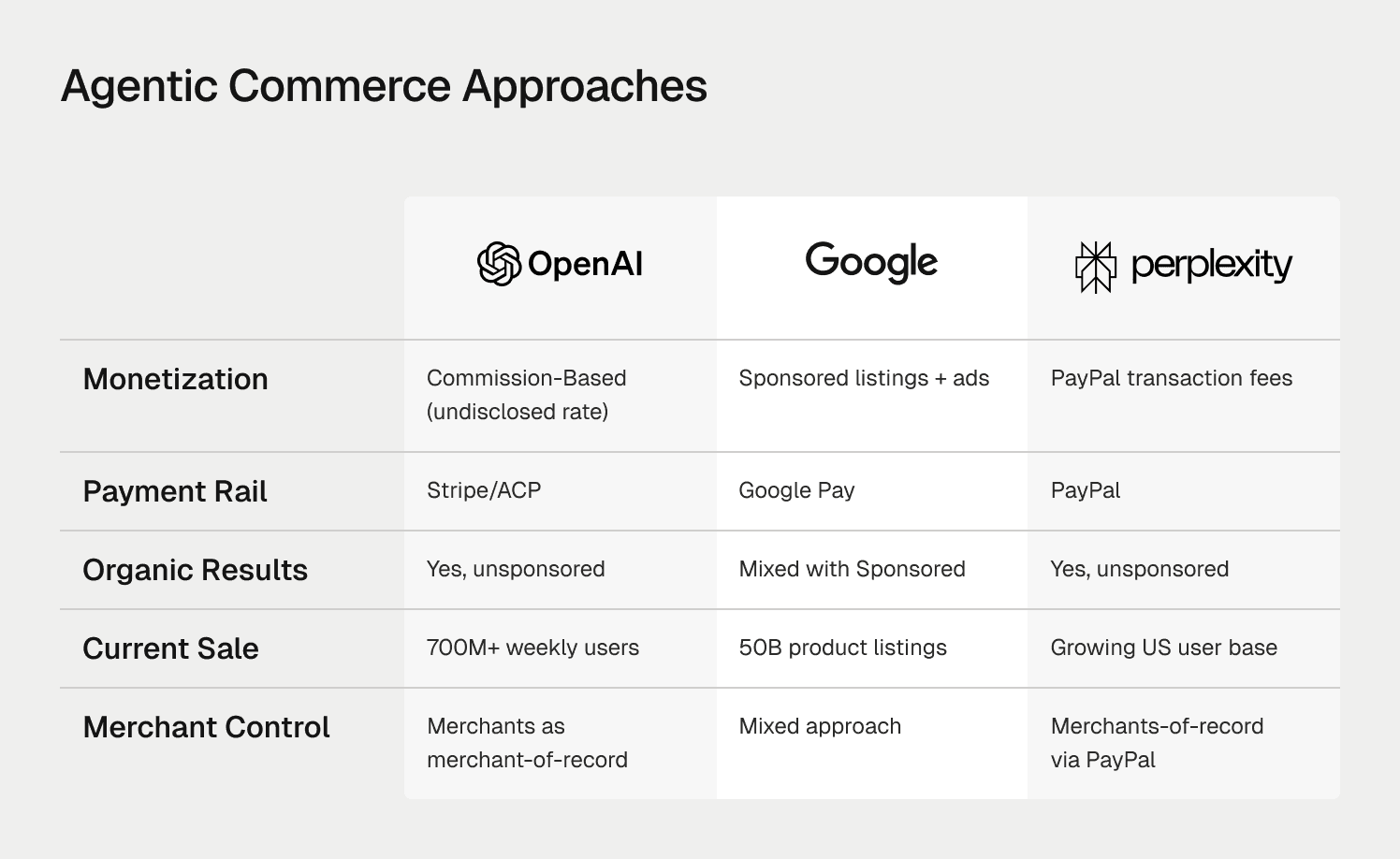
El comercio electrónico tradicional depende de un embudo de ventas lineal y de varios pasos: búsqueda, anuncios, páginas de producto, comparación y pago. El comercio agéntico unifica toda esta secuencia en un único flujo de decisión gestionado por IA.
Cuando agentes de IA como ChatGPT se encargan de evaluar y seleccionar productos, las búsquedas con alta intención de compra nunca llegan a los buscadores o tiendas habituales. En su lugar, las decisiones de compra se toman dentro de interfaces conversacionales, donde:
El posicionamiento SEO importa menos que los datos de producto legibles por máquinas y con atributos estructurados.
La influencia de la publicidad da paso a la utilidad, la relevancia y la seguridad en la entrega.
La atribución basada en clics desaparece, incluso cuando las marcas influyen de forma significativa en el resultado.
El cambio hacia el comercio agéntico altera profundamente la forma en que se descubren, evalúan y eligen los productos, y la infraestructura que hace posible esta transformación ya se está desarrollando.
Las redes de pago y plataformas como Visa, Mastercard, PayPal y OpenAI (en alianza con Stripe) están creando marcos de tokenización y APIs de pago programables diseñadas específicamente para transacciones iniciadas por agentes de IA. Un estudio de Morgan Stanley Research estima que el impacto económico del comercio agéntico podría alcanzar los 385 000 millones de dólares solo en EE. UU. para 2030, representando el 20% de toda la actividad del comercio electrónico.
Esto amenaza las bases económicas de la publicidad en buscadores y el comercio basado en tiendas online tradicionales, al tiempo que abre nuevas oportunidades para las marcas que sean interpretables por IA, compatibles con agentes y confiables para estos sistemas autónomos.
La carrera tecnológica de las compras por IA: protocolos de comercio agéntico de Google y Perplexity
OpenAI no está sola. Google —actualmente la tercera empresa más valiosa del mundo, en gran parte gracias a sus inversiones en IA— ha lanzado sus propias experiencias de compra con IA que combinan la búsqueda conversacional, el pago autónomo y llamadas del agente de IA a tiendas locales para verificar el inventario en tiempo real. Estas funciones se apoyan en el Shopping Graph de Google, que reúne datos de más de 50 000 millones de listados de productos, dando a sus sistemas de IA un profundo contexto comercial en tiempo real.
Por su parte, Perplexity AI se ha asociado con PayPal para permitir compras directamente en el chat. Esto posiciona a Perplexity no como un buscador tradicional, sino como una interfaz de IA enfocada en transacciones que prioriza la rapidez, la finalización de la compra y la mínima fricción para el usuario, por encima del análisis comparativo detallado.
¿Pueden los sistemas de riesgo diseñados para humanos proteger el comercio guiado por IA?
Con tantas inversiones fluyendo hacia la infraestructura del comercio agéntico, una pregunta crucial de seguridad sigue sin respuesta: ¿cómo se asegura una transacción cuando ninguna de las partes es humana?
La misma automatización que hace que las compras con IA sean rápidas y fluidas también crea nuevas formas de ataque. Cuando los agentes de IA compran de forma autónoma, las señales tradicionales para detectar fraudes pierden eficacia. La biometría del comportamiento, el análisis de sesión y las revisiones manuales asumen una intención y patrones de interacción humanos que simplemente no existen en las transacciones hechas por máquinas.
Algunos atacantes ya están probando con instrucciones diseñadas para engañar y manipular a los agentes de IA, forzándolos a realizar compras no autorizadas, escalar privilegios o desviar pagos.
En el comercio agéntico, la naturaleza misma del fraude cambia: pasa de suplantar la identidad de personas a explotar la lógica de decisión de las máquinas.
Una exposición al fraude de 385 000 millones de dólares
Si los pagos agénticos alcanzan entre 190 000 y 385 000 millones de dólares en EE. UU. para 2030, según las estimaciones de Morgan Stanley Research, incluso una tasa de fraude mínima se traduciría en pérdidas multimillonarias. A esa escala, el riesgo deja de ser un caso aislado y pasa a ser un problema estructural del sistema.
Cuando el volumen de transacciones es tan alto, incluso el fraude de baja frecuencia pero sencillo de ejecutar se acumula de forma rápida y constante. Los agentes de compra autónomos trabajan las 24 horas, realizan compras recurrentes y priorizan la eficiencia sobre la precaución. Esto hace que las pequeñas vulnerabilidades salgan muy caras a gran escala. No es algo teórico; los datos de adopción muestran que esta transición ya ha comenzado.
Un número importante de consumidores ya busca, compara y compra a través de sistemas de IA, con un enfoque inicial en alimentos y productos de gran consumo. Estas categorías aumentan la exposición al riesgo porque combinan una alta velocidad de transacciones, gastos recurrentes y poca revisión humana, el escenario ideal para el abuso automatizado.
El problema aumenta en entornos empresariales (B2B), donde los agentes autónomos pueden negociar contratos y realizar pagos de millones de dólares sin supervisión humana. Un solo error en un proceso de decisión puede provocar pérdidas financieras consecutivas en múltiples transacciones o proveedores.
Por esta razón, la infraestructura de riesgo debe evolucionar al mismo ritmo que los sistemas de pago, y no después de su implementación. Es por ello que Oscilar está desarrollando un sistema de detección de fraude y gestión de riesgos adaptado para IA, diseñado específicamente para transacciones iniciadas por máquinas. Oscilar se enfoca en analizar el comportamiento de los agentes, detectar patrones de decisión extraños en tiempo real y aplicar controles de riesgo adaptables en los flujos de transacciones autónomas.
A medida que aumenten los agentes de compra, las organizaciones que prosperarán serán aquellas que integren la gestión inteligente de riesgos directamente en su infraestructura de agentes, en lugar de añadir a posteriori herramientas tradicionales para el fraude.
Al nivel en el que operará el comercio agéntico, la prevención del fraude se convierte en una condición necesaria para el crecimiento, no en un simple problema operativo secundario.
El problema pendiente de autenticación y autorización en el comercio agéntico
Detectar el fraude es solo una parte del reto. La autenticación y la autorización siguen siendo problemas sin resolver a nivel de protocolo.
Cuando un agente de IA afirma representar a un consumidor, ¿cómo verifica el vendedor que esa autorización es válida, actual y tiene los límites correctos? Cuando dos agentes negocian un contrato B2B, ¿qué constituye un consentimiento vinculante y cómo se hace cumplir?
Estas no son dudas teóricas: son decisiones de arquitectura que se están tomando ahora mismo y que determinarán si el comercio agéntico se convierte en un canal comercial seguro o en una fuente constante de fraudes.
Hasta que no se resuelvan la autorización, la identidad y la responsabilidad a nivel de protocolo, la falta de confianza seguirá limitando el comercio autónomo a gran escala.
El futuro del comercio en una economía agéntica impulsada por ChatGPT
ChatGPT y otras herramientas de compra con IA representan más que una simple novedad de producto; son una redefinición total de cómo se descubre, decide y realiza el comercio.
Y las consecuencias para la tecnología financiera van mucho más allá de las compras de los consumidores. Los mismos sistemas que permiten comprar productos mediante IA facilitarán pronto los pagos autónomos entre empresas (B2B), decisiones de crédito dinámicas y negociaciones comerciales de agente a agente.
Para las empresas del sector minorista, pagos y servicios financieros, esto plantea una doble prioridad estratégica: desarrollar interfaces legibles por máquinas e infraestructura compatible con agentes de IA, mientras se construyen marcos de riesgo, autorización y fraude lo suficientemente avanzados como para asegurar transacciones autónomas a gran escala.
Las organizaciones que triunfen serán aquellas que entiendan que no estamos viendo una simple evolución de las búsquedas o los pagos, sino una reestructuración de cómo se realizan las transacciones económicas y se garantiza la confianza en una economía gestionada por máquinas.
Las empresas líderes en este entorno se encargarán de:
Crear datos legibles por máquinas sobre productos, precios y políticas.
Ofrecer procesos de pago compatibles con agentes de IA y flujos de pago programables.
Integrar controles de riesgo, autorización y fraude diseñados para IA de forma directa en su infraestructura de transacciones.
El comercio agéntico es el futuro. Pero solo si podemos confiar en él.

Linas Beliūnas
Exestratega de contenido
Linas es un desarrollador de negocios, profesional de ventas y estratega de FinTech con más de seis años de experiencia impulsando la innovación en servicios financieros. Apasionado por aprovechar la tecnología para reinventar las finanzas, ha trabajado en instituciones líderes, como Western Union, Danske Bank y Norne Securities, antes de enfocarse por completo en las FinTech. Linas está especialmente interesado en la banca digital, los pagos, las tecnologías emergentes, el blockchain y las criptomonedas. Comparte sus ideas con una audiencia global de más de 116,000 profesionales a través de su boletín en linas.substack.com.

" height="48px" id="Qi9pnIQwR" width="48px"/></g></svg>)
" height="39.77194px" id="A8r2uGwai" transform="translate(2 3.808)" width="44px"/></svg>)


" height="22.301126233991734px" id="PeyDPUyWO" transform="translate(45.365 4.852)" width="20.043580159797898px"/><path d="M 13.46 11.116 C 12.368 10.493 10.888 9.973 9.024 9.556 C 7.664 9.236 6.613 8.927 5.887 8.624 C 5.155 8.321 4.647 7.979 4.355 7.59 C 4.064 7.201 3.921 6.704 3.921 6.104 C 3.921 5.184 4.269 4.447 4.972 3.898 C 5.675 3.349 6.624 3.069 7.83 3.069 C 8.79 3.069 9.607 3.241 10.282 3.578 C 10.951 3.921 11.482 4.401 11.876 5.018 C 12.265 5.641 12.511 6.361 12.614 7.184 L 16.1 6.973 C 15.94 5.63 15.523 4.435 14.854 3.383 C 14.185 2.332 13.265 1.503 12.105 0.903 C 10.945 0.303 9.539 0 7.899 0 C 6.355 0 5.024 0.263 3.904 0.783 C 2.783 1.303 1.92 2.035 1.32 2.978 C 0.72 3.921 0.417 5.001 0.417 6.224 C 0.417 7.344 0.646 8.281 1.109 9.036 C 1.572 9.785 2.315 10.419 3.349 10.928 C 4.384 11.436 5.755 11.905 7.481 12.328 C 9.024 12.688 10.19 13.059 10.985 13.442 C 11.774 13.825 12.311 14.237 12.591 14.688 C 12.871 15.14 13.014 15.666 13.014 16.266 C 13.014 16.906 12.848 17.455 12.517 17.906 C 12.185 18.358 11.705 18.695 11.076 18.912 C 10.448 19.135 9.676 19.243 8.779 19.243 C 7.739 19.243 6.847 19.072 6.104 18.735 C 5.361 18.392 4.778 17.883 4.344 17.203 C 3.915 16.523 3.629 15.689 3.486 14.711 L 0 14.923 C 0.103 16.403 0.514 17.7 1.246 18.798 C 1.977 19.901 2.972 20.764 4.235 21.381 C 5.498 22.004 6.99 22.313 8.71 22.313 C 10.27 22.313 11.636 22.061 12.797 21.564 C 13.957 21.061 14.871 20.341 15.528 19.398 C 16.191 18.455 16.523 17.346 16.523 16.06 C 16.523 15.02 16.289 14.094 15.814 13.282 C 15.346 12.471 14.563 11.756 13.471 11.133 Z" fill="rgb(20, 20, 20)" height="22.312556870217108px" id="ZaBOTiDLx" transform="translate(68.34 4.858)" width="16.522951309374434px"/><path d="M 13.682 17.877 C 12.751 18.792 11.442 19.243 9.762 19.243 C 8.522 19.243 7.43 18.923 6.504 18.283 C 5.572 17.643 4.847 16.723 4.326 15.517 C 3.806 14.317 3.543 12.871 3.543 11.191 C 3.543 9.51 3.801 8.093 4.309 6.876 C 4.818 5.664 5.544 4.727 6.487 4.064 C 7.43 3.401 8.533 3.069 9.79 3.069 C 11.373 3.069 12.619 3.486 13.534 4.315 C 14.443 5.149 15.031 6.281 15.294 7.727 L 18.901 7.544 C 18.438 5.178 17.472 3.332 16.003 2 C 14.528 0.669 12.459 0 9.796 0 C 7.83 0 6.115 0.457 4.641 1.366 C 3.166 2.28 2.029 3.572 1.217 5.241 C 0.406 6.916 0 8.893 0 11.179 C 0 13.465 0.412 15.494 1.235 17.146 C 2.058 18.798 3.201 20.072 4.675 20.964 C 6.15 21.855 7.847 22.301 9.767 22.301 C 11.528 22.301 13.054 21.975 14.334 21.324 C 15.614 20.672 16.654 19.752 17.443 18.558 C 18.232 17.363 18.758 15.957 19.021 14.334 L 15.443 14.151 C 15.203 15.711 14.614 16.952 13.682 17.86 Z" fill="rgb(20, 20, 20)" height="22.301126257066386px" id="dj2F9fN0f" transform="translate(87.772 4.841)" width="19.020540282808156px"/><path d="M 0 21.335 L 0 0 L 3.423 0 L 3.423 21.335 Z" fill="rgb(20, 20, 20)" height="21.335239445830055px" id="fvIs54YbW" transform="translate(110.485 5.332)" width="3.423468638642248px"/><path d="M 3.429 0 L 0 0 L 0 21.341 L 13.762 21.341 L 13.762 18.272 L 3.429 18.272 Z" fill="rgb(20, 20, 20)" height="21.340954752405395px" id="KykvynROU" transform="translate(118.389 5.332)" width="13.762458233473922px"/><path d="M 9.859 3.303 L 16.077 21.335 L 19.684 21.335 L 11.991 0 L 7.693 0 L 0 21.335 L 3.635 21.335 L 9.853 3.303 Z" fill="rgb(20, 20, 20)" height="21.33523944583004px" id="Ln_a1JZTX" transform="translate(133.986 5.338)" width="19.683515845550573px"/><path d="M 11.545 12.499 C 12.968 12.059 14.043 11.322 14.774 10.293 C 15.506 9.259 15.871 8.024 15.871 6.584 C 15.871 4.521 15.191 2.909 13.825 1.743 C 12.465 0.583 10.539 0 8.053 0 L 0 0 L 0 21.335 L 3.423 21.335 L 3.423 13.071 L 8.201 13.071 L 12.802 21.335 L 16.529 21.335 L 11.539 12.499 Z M 11.173 9.116 C 10.402 9.705 9.327 10.002 7.944 10.002 L 3.435 10.002 L 3.435 3.058 L 7.944 3.058 C 9.327 3.058 10.402 3.361 11.173 3.961 C 11.945 4.561 12.328 5.435 12.328 6.573 C 12.328 7.71 11.945 8.522 11.173 9.11 Z" fill="rgb(20, 20, 20)" height="21.335239490803623px" id="Qt9AxOqZR" transform="translate(156.099 5.338)" width="16.528666547835087px"/><path d="M 33.9 0.006 L 25.607 0.006 C 25.213 0.006 24.875 0.291 24.818 0.674 C 24.687 1.555 24.47 2.4 24.19 3.201 C 23.224 5.978 21.44 8.27 19.194 9.682 L 19.217 9.682 C 19.217 9.682 25.453 9.522 27.539 3.201 L 27.539 3.201 L 30.859 3.201 C 29.482 7.161 26.459 10.133 22.778 10.968 C 22.098 11.122 21.4 11.202 20.68 11.202 C 19.514 11.202 18.394 10.991 17.343 10.596 C 14.233 9.436 11.719 6.698 10.501 3.195 C 10.216 2.389 10.004 1.543 9.873 0.669 C 9.816 0.28 9.478 0 9.084 0 L 0.803 0 C 0.317 0 -0.061 0.434 0.008 0.914 C 0.117 1.697 0.277 2.458 0.488 3.201 C 2.3 9.687 7.672 14.397 14.005 14.403 C 10.924 13.357 6.106 10.436 3.837 3.201 L 3.837 3.201 L 3.837 3.201 L 7.158 3.201 C 8.027 6.298 9.707 9.002 11.919 10.968 C 13.496 12.374 15.342 13.408 17.354 13.957 C 18.423 14.248 19.543 14.403 20.692 14.403 C 27.03 14.403 32.408 9.687 34.22 3.201 C 34.426 2.463 34.586 1.697 34.7 0.914 C 34.769 0.434 34.391 0 33.906 0 Z" fill="rgb(20, 20, 20)" height="14.402572631835938px" id="yxyckXN6_" transform="translate(0 17.597)" width="34.708059114564385px"/><path d="M 0.803 14.403 L 9.095 14.403 C 9.49 14.403 9.827 14.117 9.884 13.734 C 10.016 12.854 10.233 12.008 10.513 11.208 C 11.479 8.43 13.256 6.138 15.497 4.727 L 15.479 4.727 C 15.479 4.727 9.244 4.887 7.158 11.208 L 7.158 11.208 L 3.837 11.208 L 3.837 11.208 C 5.209 7.247 8.238 4.269 11.913 3.435 C 12.593 3.281 13.29 3.201 14.011 3.201 C 15.176 3.201 16.297 3.412 17.348 3.806 C 20.457 4.967 22.972 7.704 24.19 11.208 L 24.19 11.208 L 24.19 11.208 C 24.475 12.014 24.687 12.859 24.818 13.734 C 24.875 14.123 25.213 14.403 25.607 14.403 L 33.9 14.403 C 34.386 14.403 34.763 13.968 34.694 13.488 C 34.586 12.711 34.426 11.945 34.214 11.202 C 32.408 4.721 27.024 0 20.686 0 C 23.767 1.046 28.59 3.961 30.865 11.208 L 30.865 11.208 L 27.544 11.208 L 27.544 11.208 L 27.544 11.208 C 26.681 8.104 24.995 5.407 22.784 3.435 C 21.206 2.029 19.36 1 17.354 0.446 C 16.28 0.154 15.165 0 14.016 0 C 7.672 0 2.294 4.721 0.488 11.208 L 0.488 11.208 L 0.488 11.208 C 0.282 11.951 0.122 12.711 0.008 13.494 C -0.061 13.974 0.317 14.408 0.803 14.408 Z" fill="rgb(20, 20, 20)" height="14.408287876490093px" id="fJajgayao" width="34.70234380798904px"/></g></svg>)